
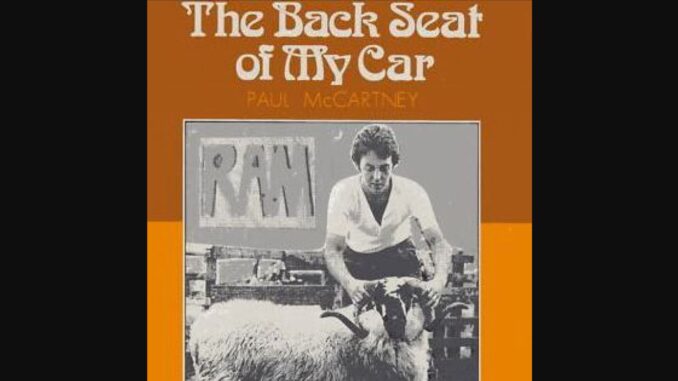
THE STORY ABOUT THE SONG: «The Back Seat of My Car» by Paul and Linda McCartney
The Back Seat of My Car is the closing track of Paul McCartney’s second solo album RAM, released in 1971 and credited to Paul and Linda McCartney.
When Paul released his first solo album McCartney in April 1970, it had included an interview press sheet with questions and answers. This is where the world learnt that The Beatles had split up, but Paul also proudly stated that he had “a queue (of songs) waiting to be recorded.”
The Back Seat of My Car was one of these songs. According to the book The McCartney Legacy: Volume 1 by Allan Kozinn and Adrian Sinclear, the song has its origins as an unfinished concept which emerged during a holiday McCartney took with then-girlfriend Maggie McGivern in Sardinia in the summer of 1968.
The actual lyrics and most of the music came later. McCartney stated in frequent interviews over the years that the many car-based songs in his late-Beatles and early solo career, such as Two of Us, Helen Wheels, and indeed The Back Seat of My Car, were inspired by the long road trips he and Linda used to take as the Beatles were breaking up. The road represented freedom, which was a huge inspiration.
Linda was American, and Paul always had a natural fascination with American music and culture in general. The song can largely be seen as his attempt at a classic American love song, with a classic American theme: driving off with the girl you love.
In the final days of the Beatles, an early version of the song was captured during the taping of the Get Back/Let It Be-film. On 14 January 1969, Paul was filmed sitting by the piano and running through the song twice. The verse lyrics were still missing at this point, but we can clearly hear that the title is being sung in the chorus. On further audio outtakes, Paul can also be heard adding some of the drum breaks vocally.
This is the only known performance of The Back Seat of My Car in a Beatle context. Only Ringo Starr is in the movie studio alongside Paul at the time, but he is not performing on it. As far as we know, The Beatles never attempted to rehearse the song.
Maybe they would have if the song was ready. At that time it simply was too early as large parts of the song still needed to be written. Later on, Paul went to work on it, and two years later the song is complete. It would become a rich tune with several different sections, not too unlike the style of the Abbey Road medley.
Like much of the RAM album, The Back Seat of My Car was given its final form in the unlikely setting of High Park Farm – Paul and Linda’s spartan country retreat on Scotland’s Mull of Kintyre, whereby the fallout of The Beatles forced them out of the spotlight and into an era of wilful austerity which in turn focused all their attentions on the one thing that meant most to them: their family.
The songs within RAM exude a pastoral existence; they were born from moments stolen in the days when Paul could relax at home, strumming on a guitar, while the lyrics suggested contentment, peace of mind, and, of course, love. Linda was his wife, his soul mate, and his muse, and naturally blended into the song writing process. Like everything else, this was a shared pleasure, as they were two young newlyweds appreciating their intimacy and solitude.
“By the time RAM came around I’d had a little chance to settle into my new circumstances with Linda,” Paul says in the book which accompanies the Archive Series Deluxe Edition box set of the album from 2012. “Now it was easier to look at future plans, because my personal circumstances were a little more comfortable. So I was able to take some time and start planning the kind of album I wanted next. […] I felt like I could have a bit more scope to do anything I wanted this time.”
The final version of The Back Seat of My Car is a great example of his newly expanded horizons, as it has been given a solid arrangement which includes both strings and horns. The song is a phenomenal end to the album, combining feelings of nostalgia, romance, and even a twist of melancholy. Musically it has a wide range of expressions, from quiet melodic ballad to a hugely grandiose climax. The song is extremely cinematic, taking the listener on a journey both musically and lyrically, before it all comes together in the reprise coda. While the song is well regarded in general, it is rarely mentioned when discussing McCartney’s merits as a composer, although it is one of his most ambitious and sweeping tracks.
Paul has always described this song as ‘very romantic.’ He was interviewed about it by Mojo! in 2001, saying “That’s a really teenage song, with the stereotypical parent who doesn’t agree, and the two lovers are going to take on the world.”
Speed along the highway, honey I want it my way
But listen to her daddy’s song, don’t stay out to long
Were just busy hidin’, sitting the back seat of my car
(Looking for a ride and all about)
(Looking for a ride in and out of town)
(Strolling around and all about)
(Looking for a ride in and out of)The laser lights are pretty
We may end up in Mexico city
But listen to her daddy’s song
Making love is wrong
Ooh, we’re just busy riding
Sitting in the back seat of my car
It’s not much of a stretch to see it as a song about the generation gap. In adolescent code, “the back seat of my car” is the place one goes to make love. The verses, with the reference to the words “making love is wrong,” symbolise the strict rules against sexuality imposed by parents, which young lovers always and everywhere try to escape.
Sometimes, the more rules you impose as a parent (“Don’t stay out too long”), the stronger the urge is as a teen to oppose them. In the song, the two teenagers decide to head out into the big wide world, chasing a feeling of freedom. There is wide-eyed optimism (“We can make it to Mexico City”), and text lines like “We believe that we can’t be wrong” is an indication of that youthful courage, their belief in themselves and in love. There is a fundamental faith that things will work out right.
Musically and structurally speaking, the song is one of the more complex compositions written by Paul McCartney. Some sections are charmingly whimsical, while others are grandiose. It starts as a ballad, builds, and goes back and forth between different moods as the song ebbs and tides, depending on how dramatic the statements of the people in the song becomes.
Paul was no doubt influenced by listening to classical music, which led him to conceive the song as a collage of recurring themes. The song demonstrates his skills as a musical arranger as he combining different melodies, moods, and sections together to form a whole – although as we’ll see, he had some help from his old friend and mentor George Martin with the orchestral arrangements.
The moving introduction to the song – a dreamy 9th minor chord played in arpeggio both by piano and electric guitar – leads into the two tuneful opening verses, so typical of McCartney’s ballads.
These two verses, which seem to be a prelude to a smooth slow song, are instead separated by two up-tempo – quasi boogie – sections, with a playful superimposition of voices sung by Paul in a curious grammelot (i.e. made-up sounds that imitates real words to convey emotion). Paul must have had fun doing it, because in some bits his barely containable laughter is audible.
The original merger of separate fragments peaks in the repeated and moving refrain that ends the song, whose dramatic tones are reinforced by the orchestral arrangement, which ranges from brass band to romantic strings.
When Paul started making plans for his second solo album, he kept in mind that his first album – 1970’s self-titled McCartney – had received some criticism for its homegrown production values. He knew that the next album had to have a more professional approach to recording, and possibly even writing, with more complete and well-structured songs.
Seeking a professional studio, but not yet feeling comfortable enough to return to the EMI studio in Abbey Road, he decided to record the new songs in Columbia Studios in New York City. He was still a man without a band, and the first thing the McCartneys did as they arrived in the big apple in November 1970 was to arrange a series of auditions to find the right people to participate in the album sessions.
Denny Seiwell was picked amongst nine hopefuls as the project’s drummer. As a guitarist, they opted for David Spinozza, who was initially hired for four weeks of work. He was part of rehearsals and recording of the songs Another Day, Oh Woman Oh Why?, 3 Legs, Eat At Home and Get On the Right Thing (kept in the can for future album Red Rose Speedway).
For various reasons, Spinozza got fed up. Amongst other things, no rehearsal space had been booked ahead of time, meaning that several scheduled rehearsal dates had to be cancelled or moved. The loose ‘let’s get a feel for things’ vibe did not sit well with Spinozza either, and he jumped ship after his four weeks were up. Officially, he was said to have other commitments and was not available when more time was needed. He was replaced by the studio musician Hugh McCracken, and with him on board, the remaining sessions were completed in November and December.
The musicians developed a way of working where McCartney, Seiwell and their current guitarist would rehearse and arrange a song during the first half of the day. In the afternoon and evening, the song was recorded, starting with the drum track and moving on to Spinozza’s or McCracken’s basic guitar tracks. Other guitar overdubs would also be completed before McCartney added bass lines and, if needed, piano.
They really got into it during these sessions. In outtakes specifically from the Back Seat of My Car sessions, Paul can be heard enthusiastically leading Seiwell and McCracken through the recording of the basic track: an amazing take that includes an awesome final jam, with piano and guitar solo. Everybody’s incredible instrumental parts can really be appreciated here, before the song got its overdubs.
Still, the recording of this song was complex and thus especially difficult to get right, as Denny Seiwell recalled in an interview with Lica Perasi in 2011: “That song took a little longer than any other because of all the movements, and the reprise coda… We celebrated when we got the good take!”
McCartney, Seiwell and McCracken recorded the instrumental backing and initial vocals for The Back Seat of My Car on 22 October 1970.
Paul proved to be skilful at recording these instrumental tracks. To the piano and bass parts, McCartney also added the dizzying guitar solo that wraps up the song, just before a brief reprise powerfully introduced by Seiwell’s drums. The drum part is acting as a comment and melodic – even more than rhythmic – support. It deserves a Golden Palm for the best percussion performance of all of McCartney’s records.
In January 1971, the sessions were moved to Phil Ramone’s A&R studios, also in New York. Only Paul & Linda were present here from the first band sessions. This was the time when additional overdubs were done, including string instruments and horn sections, which included musicians from New York Philharmonic Orchestra.
Orchestral arrangements for three songs – Uncle Albert/Admiral Halsey, Long Haired Lady, and The Back Seat of My Car – were scored by none other than Beatles producer George Martin. This was his first work with Paul since the demise of The Beatles.
“I had no problem about helping Paul with the scores for RAM,” George Martin said in an interview for the RAM Deluxe Edition book. “I must say that the final sessions with The Beatles were not at all discordant as far as I was concerned – on the contrary they were very creative and good fun. After Let It Be I never thought I could work with the band again, but Paul persuaded me to take on the final album, Abbey Road, and everything worked out fine. With RAM, as always, we worked closely and well with each other. It was a shame that the recordings happened in New York – I missed out on those. But it seemed the scores worked out OK without me!”
Interestingly, while the New York Philharmonic Orchestra is credited on the RAM sleeve notes, their archives have no track of these sessions, but pictures of some of their most prominent players were captured at the sessions and appear in the book in the RAM Deluxe Edition box set. The most likely conclusion is that some of the orchestra’s members participated in the recordings as freelancers.
“Mostly the scores were straightforward,” George Martin continues. “They are always templates which can be modified on the session. Quite often I would make on-the-spot changes to make the arrangements work better, and Paul had such a vivid imagination he could easily have done the scoring himself if he had a little instruction. I urged him to take some lessons, but he said to me truthfully, ‘Why should I when I have you?’”
A month later, the album would be completed in Sound Recorders Studios in Los Angeles. This is where the final vocal tracks were added, and where the album was mixed.
Considerable overdubbing work was done in Los Angeles. Recording engineer Eirik ‘the Norwegian’ Wangberg supervised the process, and said in a 2005 interview with Claudio Dirani: “We did lots of overdubbing, such as brand new bass and guitar tracks. […] Other cool bits were done, such as adding more vocals, such as the improvisation and ad-libs that we superimposed almost syllable by syllable.”
Technically, The Back Seat of My Car is a masterful show of skill. In it, McCartney pulled out all the stops and flaunted his whole vocal range, running the gamut from the lowest and almost cavernous bass notes of his voice all the way to a screaming falsetto. In the last refrain, McCartney probably hits one of the highest notes in his vocal range.
In addition to careful vocals’ multi-layering, voices were given different roles by McCartney, and they were used both as melodically and as rhythmic support, something it is thought to have been inspired by the techniques used by Brian Wilson.
For we was only hiding
Sitting in the back seat of my car, yeah
And when we finished driving
We can say we were late in arriving
And listen to her daddy’s song
We believe that we can’t be wrong, yeahOh oh, we believe that we can’t be wrong
Oh oh, we believe that we can’t be wrong
We can make it to Mexico city
Sitting in the back seat of my car, oh oh
As mentioned, the final album was credited to Paul and Linda McCartney. This is the only album where the married couple share credit in this way. At the time, Paul explained several times that this was the first album where they had truly collaborated as songwriters and musicians. There was another important reason for crediting her: he wanted to dodge his publishing deal. He was still signed to the publishing company Northern Songs, just like John Lennon was, and anything from songwriting credits to album royalties were shared within that set-up.
Paul was not making much money during this period, as his financial assets and income was tied up in their record label Apple Corp. and controlled by Allan Klein. By giving Linda partial songwriting credit, her part of the songwriting split would go directly to her, giving the family some concrete income.
It is no doubt true that Linda added something to a lot of the songs, but few believed it tallied up to the 50/50 split that the credits indicated.
Consequently, ATV (the owner of Northern Songs) sued the McCartneys over their new songwriting split, claiming that Linda did nothing, that their way of crediting the songs were a ploy, and that any new Paul songs were bound by his publishing deal. Linda had to testify, and had to state in court that she was competent enough as a songwriter to be able to make music with Paul McCartney. Macca himself added that he should be able to write music in whatever way he saw fit, and with whomever he wanted to.
No decision was ever made in the case. A settlement was reached where Linda would be compensated for her compositions, and Paul had to produce a TV special for ATV. This special was eventually recorded in 1973, and aired shortly after on 16 April (US) and 10 May (UK) with the title James Paul McCartney. It was issued on DVD for the first time as part of the super-deluxe Red Rose Speedway box set in December 2018, and released.
RAM was finally let loose into the wild on the 17th and 28th of May 1971 in the US and UK respectively. It was warmly received by the public, who clearly was keen for a new McCartney album. It went to the top of the British music charts on 3 July 1971, also achieving a strong #2 placement in America.
The press proved to be harsher critics than the record-buying public, and their caustic comments opened wounds that would take years to heal. Few were as negative as Jon Landau, who wrote a scathing appraisal of the album in Rolling Stone Magazine. He called the album “incredibly inconsequential” and “monumentally irrelevant.” He proceeds to tear apart individual songs, concluding that Paul’s career is nothing without the other Beatles. In spite of the album’s strong sales, this criticism truly stung.
“It’s such a sordid subject,” Paul reflected several decades later in the RAM Deluxe Edition book. “Yeah, you pay attention to reviews, because you normally read the magazines that they’re going to be in, and you don’t always know there’s going to be an review of your album. So, you’re reading away happily and then you turn a page and there it is. And you’re fascinated to read it, but you do it with great trepidation, because even if it’s a great review, there’s always one little line where he says, ‘Well, the low spot of the album is…’ and that manages to bring you down for the whole day. I’ve learned not to care about what they say, because they are just people, they are not God. So their opinion can often be wrong, or it can often be different from the people who are going to buy the record.”
Going back to Jon Landau’s review, he was actually complementary of The Back Seat of My Car, describing it as “one of only two good songs I enjoyed on the album” (the other one being Eat At Home). Landau further described the song as “the album’s production number.” Nice sentiments in isolation, but unfortunately written in such a way that they too end up being huge backhanded swipes at the rest of the album.
Years later, Rolling Stone would rectify their opinion on the album, perhaps aware of the damage they’d caused. Meanwhile, other reviewers were more nuanced, often praising RAM’s originality. Hit Parader applauded its “clever arrangements” while Billboard dubbed Paul and Linda “the sweethearts of rock’n’roll reborn.”
Perhaps the album’s biggest problem was that the artist was Paul McCartney. For better or worse, to most people he was on a pedestal. He was expected to deliver music that lived up to the impossible standards that McCartney himself had been part of establishing with The Beatles. Simple songs about country life, for example, did not at all sit well in this context. People had ideas about what they wanted from Paul McCartney, and were harsh if what they were served didn’t match that expectation.
The review by Chris Charlesworth in Melody Maker is a good example of this. He called RAM a good album “that was a lot better than most British releases. The problem is that you expect far too much from a man like Paul McCartney.” He somewhat sympathetically concludes: “It must be hell living up to a name.”
The Back Seat of My Car is easy enough to listen to, even though it’s not an immediate song to grasp as a whole. It was nevertheless chosen as the album’s single in the UK. In McCartney terms it was a resounding flop, only making it to #39 on the charts. Melody Maker’s critic Chris Welch reviewed the single, and said “It’s not the most thrilling of songs. So far I have played this seven times in succession. In the final analysis it proves a unmemorable performance.” The song has more than outlived asinine opinions like this one, but it is clear that the multi-layered and ambitious track wasn’t the best choice for a single. Some songs shine brightest from within the album format, and The Back Seat of My Car adds a ton to RAM, working phenomenally well as an end section.
In North America, Uncle Albert/Admiral Halsey was chosen as a single instead. This may not be the most straightforward of tracks either, but it still fared significantly better, topping both the US and Canadian charts and even winning a Grammy.
The relative failure of The Back Seat of My Car as a single may have led its creator to mentally put it aside, as it unfortunately has never been in any of McCartney’s live setlists. It came close to being included during the 2002/03 Driving’ Rain Tour, when the song was rehearsed by the band and ready to go. Sadly it got no further than that, even though it was among the band’s own favourites to perform at that time. During a show in Mexico City in 2017 Paul did however tease the song, playing the piano while singing the ‘We may end up in Mexico City’ line – twice, even, for extra emphasis. People loved the home town reference, and it was a great chance for the full song to finally appear, but no. That’s all, folks.
Bad reviews clearly stung at the time, but fortunately Paul was firm in his belief that he had delivered a great album. The album and US single had been very successful, which motivated him and even gave him the itch to put a new and proper band together. This was a big step forward, taking him out of the slump he’d found himself in over how The Beatles had ended. Now, the foundation had been put in place to allow his next project Wings to take flight. But that is another story…
Facebook Comments