

It was late October 1968. Local heroes MC5 were playing live at the Grande Ballroom in Detroit on the 30th and 31st, recording their first album live in the process.
The evening had just about gotten started. The band had opened with the track Ramblin’ Rose and the feeling in the air was electric. MC5’s vocalist and frontman Rob Tyner had fired up the audience with slogans like “I want to hear some revolution out there!”, asking them to decide whether they were part of the problem or part of the solution.
MC5 very much embraced the feeling of change being in the air and were not shy about encouraging direct action. This was very much part of the counterculture of the late 1960s, and it was in the air at the Grande Ballroom that night.
The time had come for the next song. Rob Tyner stepped up to the microphone with a sharpened presence, the entire band coming together behind him, ready to jump onto what was going to happen next. They looked focused and ready. You could tell that something was about to happen. The crowd grew quiet, keen to hear what the frontman would say next.
Tyner stared out at the crowd and determinately said, “Right now! Right now! Right now, it’s time to…”
He stopped. The final part should not just be said outright. He held it back. The place went quieter, the air thick with anticipation. One of the guitar players quickly checked if he’s in tune. Every second lingered for several moments. I imagine tumble weeds rolled across the stage, a bird cried in the distance, and a quiet wind blew.
Tyner allowed the moment to linger just about long enough, and it worked. He had everybody’s attention.
Finally, he shouted out the immortal words that would define the rest of the band’s existence.
KICK OUT THE JAMS, MOTHERFUCKERS!
The band launched into what would become their signature song. It was the sound of MC5 marching into rock’n’roll history.
Well, I feel pretty good, and I guess that I could
Get crazy now, baby (Come on)
‘Cause we all got in tune a-when my dressing room
Got hazy now, baby
I know how you want it, child, hot, quick and tight
The girls can’t stand it when you’re doin’ it right
Let me up on the stand
And let me kick out the jam
Yes, kick out the jams
I want to kick ’em out
The song itself, as much of the music on the album, is raw, in-your-face, savage, and raging. For most people, it would be an impactful introduction to a band with a lot of anger and frustration to get out of their system.
The music played by MC5 that night was hard rock to the full extent that it existed in 1968. We were still a few calendar years away from Black Sabbath’s doom-laden debut album and the thunderous energy of Deep Purple In Rock, neither which emerged before 1970. Detroit’s biggest sons, The Stooges (led by Iggy Pop) came from a similar place, but would not release their debut album until the following year. While the world had seen some powerful performances from the likes of Steppenwolf, Blue Cheer, Jeff Beck Group, Cream, and The Who, the world had never quite seen the reckless abandon of MC5’s aural assault that Kick Out the Jams represented – especially when coupled with that introduction!
MC5 is short for Motor City Five, which they were known as initially. They had been formed in Lincolm Park, Michigan, in 1963. In addition to the frontman Rob Tyner, their classic line-up consisted of guitarists Wayne Kramer and Fred “Sonic” Smith, bassist Michael Davis, and drummer Dennis Thompson.
The band quickly established themselves as a musical force on the Detroit live scene, releasing two independent singles in 1967 and 1968 respectively: I Can Only Give You Everything (made famous by The Troggs) and Looking At You. These were repressed several times as the band’s live reputation kept growing, which helped convince Elektra Records to sign the band in 1968.
The label was keen for the band to enter the studio to record their debut album, but the band hesitated. Wayne Kramer told Classic Rock Magazine: “Playing live was what we did best. Most bands did three albums and then a live album, so we thought we’d be revolutionary and break out with a live album first. It also worked better for the label. MC5 didn’t know how to work in the studio, so a studio record could have cost Elektra a fortune and been a lengthy, gruelling process.”
Elektra went along with the band’s suggestion, which leads us to the booking of Detroit’s Grande Ballroom on 30 and 31 October 1968. These were incredible shows, capturing the band at their most inspired and inspiring.
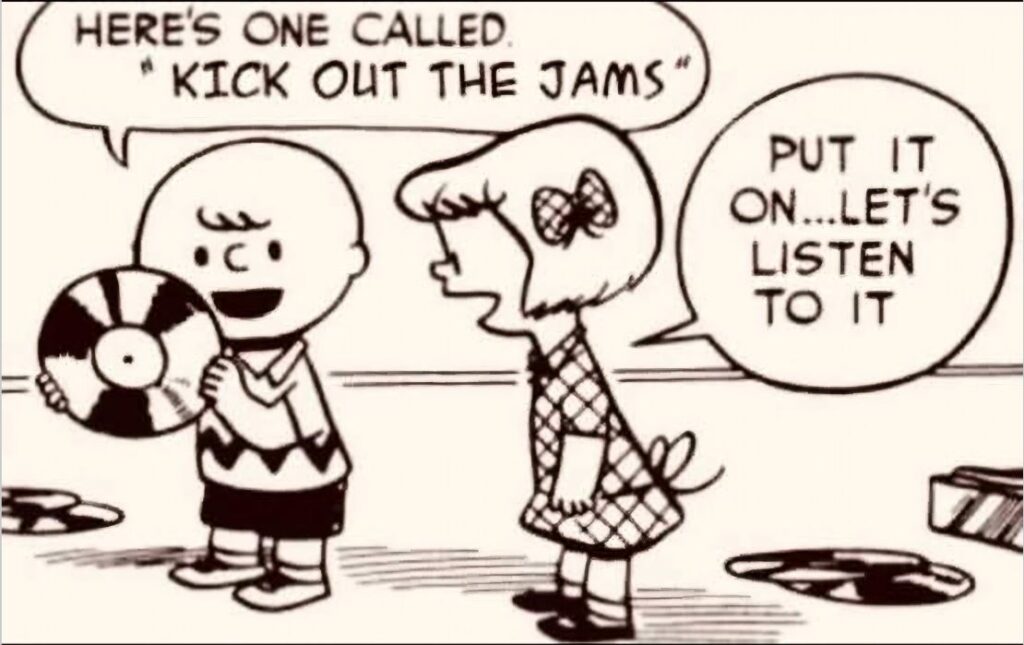
At the end of the day, what people talked about and ended up remembering was the notorious title track with its unforgettably controversial introductory exhortation.
Before we get to the repercussions that followed, let’s examine the song’s origins. Every one of the band’s original compositions bear a communal ‘MC5’ credit. Is this accurate, though? Did they all write all the songs together, and if not, who did?
“We were commune-ists,” Kramer says laughing in conversation with Classic Rock. “We had this all-for-one, one-for-all… I hesitate to call it a business structure. We just saw ourselves as one unit, but it was Rob Tyner and I that wrote Kick Out the Jams in the kitchen, smoking a joint.”
The band was going through a very creative period. They had just moved in together for the very first time, having found a very suitable building in downtown Detroit. “It was a dentist office on the second floor,” Kramer revealed to Songfacts. “We all moved into different rooms in the dentist’s office as our bedrooms, and then downstairs was a storefront. I covered the walls with egg crates and made it a rehearsal studio, so for the first time we could rehearse whenever we wanted to – all day, all night if we wanted to – and we all lived there. So, it became possible to really develop some songs and some music. And Tyner and I developed a little habit of sitting down at the kitchen table with a couple of joints, a little amp, my electric guitar. He’d have a notepad, I would just play guitar riffs, and he would listen and say, ‘Wait, wait… play that one again. No, change that a little bit. OK, play that again. Play that four times.’ And then we would start to cobble the songs together. That was where Kick Out the Jams was born.”
“Tyner was really speaking to us, the rest of the band. Sometimes I was critical of him, and what he’s saying is, ‘let me be who I am.’ Because who he was was fantastic. He was your dream lead singer, and he wrote lyrics that work so well, on so many levels.”
“Kick out the jams” as a phrase has been taken to be a slogan of the 1960s ethos of revolution and liberation, an incitement to “kick out” restrictions in various forms. So what did the band talk about when they say ‘kick out the jams’?
Wayne Kramer has mentioned a couple of meanings, which likely all apply. First off, he told Classic Rock that “…if you’re going to do anything, do it full measure, don’t equivocate, be all the way in.”
Also, in an interview with Disc & Music Echo magazine on 8 August 1970, he said: “We first used the phrase when we were the house band at a ballroom in Detroit, and we played there every week with another band from the area. […] We got in the habit, being the sort of punks we are, of screaming at them to get off the stage, to kick out the jams, meaning stop jamming. We were saying it all the time and it became a sort of esoteric phrase.”
In a discussion with Songfacts, Kramer revealed that “We were using the expression for a long time, because we would be critical of other bands that came to Detroit that the MC5 would open for. They’d come into town with this big reputation, and then they’d get up on stage and they weren’t very good. So, we used to harass them. We’d yell at them, ‘Kick out the jams or get off the stage, motherfucker!’ Finally, one day we said, ‘I like that expression. We should use that as the title of a song.'”
In those terms, the expression is quite literally telling certain types of bands to kick out ‘the jams.’ The late-60s scene had plenty of bands that played long, involved, loose sections of music, as exemplified by The Greatful Dead’s infamous cover of the Bobby Bland song Turn On Your Love Light at the Woodstock Festival which lasted some 40 minutes. The song didn’t end because the band had finished the song, but because the stage amps overloaded, abruptly ending the song and their set.
For the record, Bobby Bland’s original runs approximately 2 minutes and 30 seconds.
“They were the recipients of much of our harassment,” Kramer told Classic Rock. “All those San Francisco bands, we were tough on everybody. This was the era of the twenty-minute guitar solo, the forty-minute drum solo. The MC5’s roots are in Little Richard and Chuck Berry. That’s where we were based and everything grew out from there. We went from Little Richard to Sun Ra, all wrapped up in the era of Vietnam, civil rights, and youth rebellion.”
The phrase of the song title has also been reinterpreted as an establishment message masquerading as a revolutionary anthem. On his 1969 self-titled album, David Bowie sings in the song Cygnet Committee: “[We] stoned the poor on slogans such as/Wish You Could Hear/Love Is All We Need/Kick Out the Jams/Kick Out Your Mother.” The song is a dystopian narrative about a man who helped revolutionaries establish a new order by “open[ing] doors that would have blocked their way.” Let’s leave it at that.
Diving back into ‘motherfuckgate’: it goes without saying that the Electra Records executives had a problem with that line. Even if they accepted the fact that some music should be allowed to have sharp edges, they knew that this would get in the way of the record’s availability and commercial potential. They wanted it edited out of the album, while the band and their manager John Sinclair (yes, the same John Sinclair that John Lennon famously wrote a song about in 1972 – but that’s another story…) adamantly opposed this.
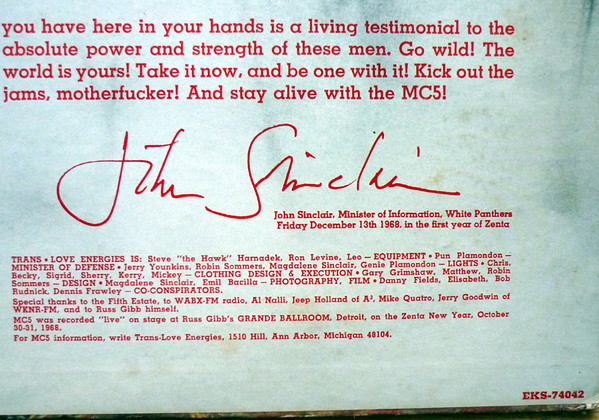
To make matter worse, the slogan was heavily featured in the album art. The original release repeated the ”kick out the jams, Motherfuckers!” line as part of John Sinclair’s write-up on the inside of the gatefold album cover. Expletives were not yet normal on albums, whether in audio or written form. It they were there, they were a bit tucked away.
One such example can be found on Jefferson Airplane’s song We Can Be Together, recorded a few months later for their Volunteers album. That song also contains a “motherfucker,” yet unlike Elektra, RCA Records released the album wholly uncensored because the word hadn’t been placed front and center.
It was a different story in MC5’s case, though. The word was unavoidable, placed on a figurative pedestal, especially on the single as it was one of the first words you heard. The work packed a heavier punch then than it does now. It was able to cause offense on levels where careers could be ended.
The band was not insensitive to this. They had actually recorded a clean introduction that they felt could be used for the single and radio play, where Rob Tyner screams “kick out the jams, brothers and sisters!” Their idea was to save the ‘motherfucker’ for the album.
“We weren’t complete idiots about it, you know,” Wayne Kramer explained to NPR’s Terry Gross on her Fresh Air radio show in 2002. “We knew the MF version would never be played on the radio. So we recorded an alternative intro, which was ‘kick out the jams, brothers and sisters.’”
The band suggested to Elektra Records to release the ‘brothers and sisters’ version as a single first, letting it establish itself in the charts and potentially giving the band a hit. They wanted the album to be released later, featuring the MF version of the song, once the single started dropping down, ending its chart run.
This does sounds like a good plan. Unfortunately, the label ignored it completely.
”We knew that when the album version, the real MF version hit the stands, that the stuff was going to hit the fan,” Kramer continues. “But why not let the single get as firmly established in the charts as it can first? Wait till it starts coming back down the charts before you put the album out, because then we’ll be a bona fide hit band. Also, then the controversy will work in our favour. And the record company, in all their shortsighted lack of wisdom, when the single started going up the charts, they rushed the album out. And when they rushed the album out, of course, the stuff did hit the fan and the – and people started to be arrested for selling the album.”
It’s even worse than Kramer remembers it, as the label actually put out the album first, ahead of the single.
MC5’s first album, Kick Out the Jams, was released on 22 February 1969. The date was uncertain for a long while, but Rhino Records, which has access to Elektra’s archives, published a retrospective a few years ago which included the exact release date. The single featuring the song of the same name was released the following month, on an as-of-yet still unspecified day in March 1969.
This release strategy makes no sense, especially given the label’s own misgivings about the MF version. It did not prevent their fanbase from rushing out and getting the album, which crashed into the Billboard 200 to peak at an impressive #30. The #1 album in America that week was the original cast recording of the Broadway production Hair.
The single also charted when it appeared, peaking at #82 in the Billboard Hot 100 singles chart – a feat, given how quickly it was taken off the market.
The album gloriously featured the MF version of the song, while the single took the safer approach by appealing to the ‘brothers and sisters.’ Still, the single came too late. The damage had been done, as it didn’t take long for the album – and the single – to be pulled from stores.
The label’s response was to replace the initial version of the album with a ‘brothers and sisters’ version. This would totally remove the MF version of the song from the marketplace. The cover was also reworded to exclude the MF phrase. The remaining copies featuring the uncensored audio version would be sold behind record counters rather than returned.
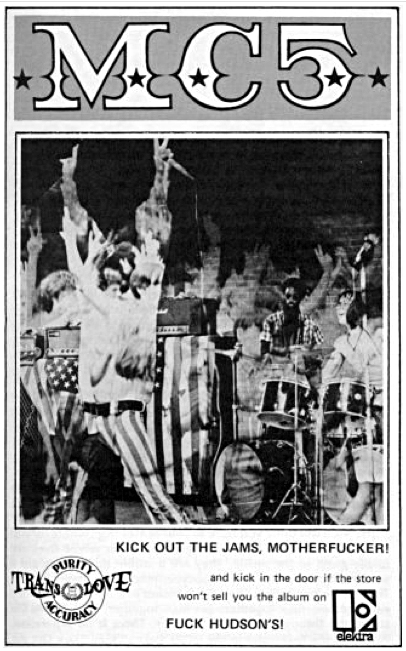
The controversy escalated into an outright war between the band and Hudson’s department stores, as Hudson’s refused to carry the album even after a censored version was available. MC5’s response? They took out a full-page ad in the local underground magazine Fifth Estate that mainly featured a picture of Rob Tyner, with the text “KICK OUT THE JAMS, MOTHERFUCKER! And kick in the door if the store won’t sell you the album on Elektra! FUCK HUDSON’S!”
What made it worse was that their ad prominently carried the Elektra Records logo. In return, Hudson’s immediately refused to carry any album from the Elektra label.
This full-blown feud was one that Elektra hadn’t been aware of and wanted no part of, and their hand was largely forced. To end the conflict and to avoid further financial loss, Elektra dropped MC5 from their record label.
MC5 would move on. They signed with Atlantic Records and made a few more records with future Bruce Springsteen producer Jon Landau at the helm. They did well, but never managed to reach the peaks attained on their first album and its singles.
The band called it a day with a farewell show on 31 December 1972 at the Grande Ballroom, the location of their iconic first album recording. They would have several reunion periods between 1992 and 2024. The death of Wayne Kramer on 2 February 2024 effectively ended the band for good.
MC5 are considered one of the most influential hard rock bands of all time, with both Parade, Rolling Stone and VH1 having paid tribute to them in general, and to their debut album and song Kick Out the Jams in particular.
“I never tire of playing it,” Kramer told Classic Rock. “It’s exciting every time. Even acoustic. Excitement’s built into the song’s DNA. There’s no way to play that song and be boring. It can’t be done.”
Facebook Comments