
For AC/DC, 1980 would become a year of incredible highs and lows. It started horribly, with the death of their charismatic frontman Bon Scott on 19 February. The loss was devastating, and the band instantly considered breaking up, but friends and family (particularly Bon Scott’s) persuaded them to carry on.
After Scott’s funeral on 1 March, the band began auditions for a new frontman. Replacing Bon Scott was an almost impossible thought. The man had it all – stage presence, charisma, a shared Scottish/Australian lineage with band founders Angus and Malcolm Young, and not the least a unique, powerful, and instantly recognisable voice. Who could possibly step into those shoes?
As it happened, Bon Scott himself had already pointed the way. “I remember the first time I had ever heard Brian’s name – it was from Bon,” Angus Young recalled in the book AC/DC: Hell Aint a Bad Place to Be. “Bon had mentioned that he had been in England once touring with a band, and he had mentioned that Brian had been in a band called Geordie and Bon had said ‘Brian Johnson, he is a great rock and roll singer in the style of Little Richard.’ And that was Bon’s big idol, Little Richard.” Scott was more or less telling the band that Johnson would be a great replacement if anything were to happen to him.
Angus continued: “I think when he saw Brian at that time, Bon concluded ‘Well, he’s a guy that knows what rock and roll is all about.’ He mentioned that to us in Australia. I suppose when we decided to continue, Brian was the first name that Malcolm and myself came up with, so we said we should see if we can find him.”
They brought in the Geordie singer, who impressed the group not just vocally, but socially. “We were all sitting there going, Where’s this guy Brian? He should have been here an hour ago,’” Malcolm Young later recalled about Johnson’s audition in a Classic Rock interview. “‘Oh him? He’s downstairs playing pool with the roadies’ – so we thought, well, at least he plays pool.”
“He was as sad about Bon as we were,” Angus added in the same interview. “Anyway, we said, ‘Do you want to give it a go?’ And he said, ‘I do Whole Lotta Rosie with Geordie,’ and off he went. We went, ‘This guy is cutting the mustard. Anything else you know? Nutbush City Limits? OK, we can knock that out,’ and he sang that great too. It put a little smile on our faces – for the first time since Bon.”
The audition went really well, but they had other people lined up to try out as well. They worked their way through the rest of the candidates almost begrudgingly, their mood lifting once again when they brought back Johnson for a second rehearsal.
There was no doubt, and on 29 March – much to Johnson’s surprise – Malcolm Young called him to offer him the job.
Their first album with Johnson was Back In Black, released on 25 July the same year. The album shouldn’t need much of an introduction. Back In Black went on to become one of the biggest selling albums of all time, reaching the level for 25x Platinum in the US alone. It is still widely considered as one of the most influential hard rock albums of all time and a watermark for hard rock music. It is continually featured near the top in «best of»-lists covering hard rock and metal genres.
A lot has been written about Back In Black over the years, and deservedly so. The album’s success was reassuring beyond the amount of albums sold, as Angus Young shared told Classic Rock in 2022: “We knew that this new line-up would work, and that we wouldn’t have to worry about the past any more. We had found success with a new voice, and that was a big relief.”
Success brings its own challenges. How the heck does one follow up such a wildly successful album?
“Of course, the label wanted [the next album] to sell just like Back In Black did, but we knew damn well that’s not going to happen cos you can’t do that,” Brian Johnson told Classic Rock in 2022. “You can’t write songs with the intention to sell a million singles or albums. We never felt any outside pressure, because we didn’t let it in. We were very confident after the success of Back In Black. And we had every right to be.”
AC/DC had recorded seven albums over the previous six years. They had appreached each and every one of them in their usual down-to-earth, business-as-usual fashion: write songs, rehearse the best ones, and record them with a live feel. That had always worked just fine, maybe because they had been left alone to do what they did best. There had been one or two attempts to write songs to order, like the time the record label had requested that the band record a ballad, but those attempts didn’t work and were abandoned.
RELATED ARTICLE: When AC/DC were told by Atlantic Records to write a ballad
The success of Back In Black saw the bands take giant leaps in record sales. This made certain people start paying attention. AC/DC were about to discover that they’d reached the level where the label now took a more active interest in the material that was produced. They started having opinions.
The five members of AC/DC (Angus and Malcolm Young, Brian Johnson, bassist Cliff Williams, and drummer Phil Rudd) were still in business-as-usual mode as they travelled to Paris in the early summer of 1981 to start recording Back In Black’s follow-up.
On the surface, the building blocks for even more success were solidly in place. They would continue to work with Robert John “Mutt” Lange, who had produced the previous two albums Highway To Hell and Back In Black. Both of them had been solid successes that had lifted AC/DC to new heights, and the label was more than happy to support Lange’s continued work with the band.
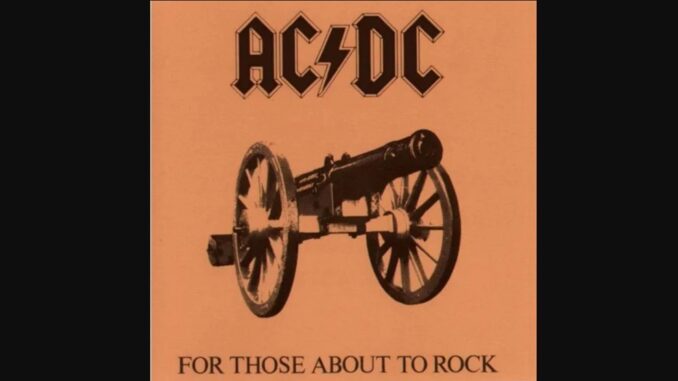
The band also had most of the songs ready. They even had a title ready for the new album: For Those About To Rock (We Salute You) – shortened to just For Those About To Rock on the album cover (and after this point in this text). The title rang out as both a call to arms and a tribute to the fans who had elevated them to their current position.
Stand up and be counted
For what you are about to receive
We are the dealers
We’ll give you everything you needHail, hail to the good times
‘Cause rock has got the right of way
We ain’t no legend, ain’t no cause
We’re just livin’ for todayFor those about to rock, we salute you
For those about to rock, we salute you
The first week in Paris was spent rehearsing the album in a former factory outside of the city – at the Arabella apartments in the Montmartre. The building was rather desolate and they all hated it. It certainly was a long way from Compass Point studio in Nassau, the Bahamas, where they had gone to record Back In Black.
On Monday 6 July 1981, AC/DC turned up at EMI’s Pathé Marconi studios in Paris to start actual recording with Lange. As they assembled in the studio, no one was looking forward to the sessions.
It was not just about the location. A lot of it had to do with the draining process they knew they were facing working with their producer.
The success of their previous two albums had come at a price. Lange was a perfectionist who tended to focus on individual sounds and recording an album much the way you put together a jigsaw puzzle. He didn’t see the value of capturing a band live in the studio. Lange strived for perfection in sonics and in performances, and he did not see the beauty of imperfections or accidents that happened in the moment of a performance. This meant that each and every note would be recorded in isolation and would face much scrutiny.
Lange’s penchant for repeated takes would reach its apotheosis with Def Leppard’s Hysteria (1987), which took nearly two years of studio work to complete. His meticulous, borderline OCD approach to record production did help take AC/DC to the next level of success, but his methods were creating severe tensions within the band. They had been through two long hauls with Lange and were dreading yet another one.
Graham ‘Buzz’ Bidstrup was the former drummer for the Australian rock band The Angels, who toured with AC/DC in the early days. He had worked in the studios where AC/DC recorded their earlier albums with George Young at the helm, and recalled how “when they recorded back then they just did it like playing a gig. Bon would be grinning and giving it loads, drinking and sweating, and Angus would be flying all over the studio, rolling round on his back.”
With Lange in charge, the studio was a very different place.
Mark Dearnley was Lange’s engineer on the Paris sessions. He had first worked with the producer and the band on Highway To Hell. “Mutt has a picture of the way he wants to hear it in his head, and will keep on bashing away until we hit that particular note that he has,” Dearnley told Classic Rock. “And sometimes it can take some time. They spent the first three days in Paris just on the snare drum sound. It got to the point where at the end of day two Mutt said: ‘What do you think of that?’ I said: ‘I haven’t got a clue!’”
The EMI studios would prove challenging as far as getting the sounds the producer wanted. After 10 days, Lange decided he was never going to get the sounds he wanted in that studio. He called a halt to the sessions while another studio was hastily found.
This was the start of a frustrating couple of weeks, where they kept trying out a number of different studios for a day or two each, the producer not being satisfied, and they all moved on again.
In the end, Lange decided that a previously considered rehearsal room – the cold, stone room at Quai De Bercy – was their best option. He ordered the Mobile One portable recording studio from London to be set up outside of there, giving the location the means to record things properly. This is where most of the album – including the iconic title track – would come together.
The title and central lyric of For Those About To Rock (We Salute You) is a variation on the phrase “We who are about to die salute you,” which is what Roman gladiators would say to the high rulers (typically the emperor), before fighting to the death in the arena. There’s also an ancient salute used by Roman prisoners to be executed in the Colosseum: “Ave, Caesar, morituri te salutant” (“Hail Caesar, those who are about to die salute you”).
In February 2021, speaking to Zane Lowe on Essentials Radio on Apple Music 1, Angus Young stated that the inspiration behind the song came from a book by British poet and novelist Robert Graves. Young explained to Lowe that the song’s title was originally inspired by a twist on a line by Graves:
“For Those About To Rock, it came out with Malcolm and myself, it was a combination,” Young explained, revealing how he wrote “a little guitar thing” in the intro to the song, and Malcolm “had this little guitar chordal progression.”
“So the two of us worked on that and we came up with the verse idea of it,” Young continued. “And the funny thing is, when we got to the chorus, we were going, “Okay, what are we going to sing on this?” And for me, I just thought, well, sometimes I go back to something I’ve read somewhere, and there was the writer Robert Graves. He did a lot of history stuff, and had a book that I had read called “For those about to die,” and he went into a day in the Coliseum and the thing that the gladiators did. And I thought, “That might fit.” So it was a case of, if I can come up with a way of singing something that can sing into it. I think at first Malcolm thought, “Wait. What is he on?” And I’m going, “Well, for those about to …” And I got it in, I got it all in, “For those about to rock.” So that kicked off that.”
The twist in the plot is that Robert Graves never wrote a book called For Those About To Die or any other book featuring that phrase in a Roman gladiator setting. It’s more likely that the book Angus is referring to is Those About to Die by Daniel Mannix.
The song prominently features the sound of cannons firing. The idea to incorporate them came from a very different source: the wedding between Prince Charles and lady Diana Spencer.
This tells us that the band were actively working on the album’s title track on 29 July 1981, which was the day of that wedding. Angus recalled that “someone had the wedding on in the next room … we were playing that part of the song while the cannons were going off on the TV, and we paused a second and went ‘hmmm … that actually sounds pretty good.'”
Hearing those cannons fire was a true lightbulb moment. “I just wanted something strong,” he later told Classic Rock. “Something masculine, and rock’n’roll. And what’s more masculine than a cannon, you know? I mean, it gets loaded, it fires, and it destroys.” Bon Scott would no doubt have added that there could be something sexual about a cannon, too.
The sounds of the cannons firing were recorded live over the course of July and overdubbed into the song, again using the Mobile One recording truck. The cannon sounds were mixed with the sound of exploding fireworks, as they provided more of an exploding sound effect than the actual cannons did.
In addition to the aural firepower that the cannons represented, they provided a powerful imagery as well. This led to a cannon being featured on the cover of the album and single, as well as life-sized Napoleonic cannons becoming a regular stage prop at AC/DC concerts. They had already augmented their show with nontraditional instruments on the previous tour, when an enormous bell was brought onto the stage to ring in the track Hell’s Bells. Adding cannons to the next tour seemed a natural progression.
As pleased as the band was with the title track of the new album, they were deeply frustrated with the whole recording process. The whole process of trying out several studios and spending days on end searching for the correct sounds to use had caused some serious delays. It had started eating away at the band.
Angus has made it clear in many interviews that most, if not all of the songs had been written long before they got to the studio. “We are always well prepared,” he told Classic Rock. “We go in the studio with complete songs and we know what we want. We don’t fuck around much. Unlike Mutt Lange. But that guy has always been slow – real slow. He’d need forever to get anything done. Otherwise it would have been in and out in a week, I’d say.”
Anyone dropping by the studio while AC/DC were recording wouldn’t have seen anything untoward. Johnson and the Young brothers spent much of their time perched on a large sofa, waiting for Lange to finish tinkering. “Bored shitless,” Angus says succinctly. Malcolm was even less impressed, pissed off at what he saw as Mutt’s “fannying around.”
Lange, in return, had started to question every aspect of the band’s operation, according to Jeffery. Added to his personal hit list, where Atlantic and Lange now vied for top spot, was the band’s management.
“[The band] felt that they were being compromised,” Jeffery told Classic Rock. “Stuck out in Paris they felt isolated. They were struggling with the record, to start with. They were starting to get into contentious situations with Mutt. It wasn’t flowing in the studio. They weren’t writing like they were used to. That whole side of things wasn’t happening.”
As the sessions started to stretch into August, they were getting in the way of long booked live appearances, especially the first show of the year: headlining the Monsters of Rock festival at Castle Donington.
The date had been booked months before. The album sessions had started in early June, and they just hadn’t imagined they would still be going on throughout (and beyond) August. They had managed to record Back In Black in just six weeks (from mid-April to May 1980), while Highway To Hell took three (24 March-14 April 1979). What had taken weeks with the same producer was suddenly taking months.
Monsters of Rock was hugely important to the band – their biggest ever show in the UK. This was not how the band has imagined themselves preparing for it. “We were shitting ourselves,” Johnson recalled. “‘Fuck, we haven’t played this! We haven’t rehearsed anything!’”
In the end, the audience seemed appreciative of the band’s performance and was glad to see them, but they knew they had performed under par. That was very hard to acknowledge, and they never forgot that feeling.
It didn’t help that the day had several unfortunate circumstances. For starters, the weather was dreary and wet, dampening the mood of bands and audiences alike. Malcolm was stopped by an overzealous security guard as he walked the ramp to the stage, as he had the wrong stage pass. The live sound was poor (a general problem at Donington 1981), and with no time to rehearse, they had to rely on the same set they’d been playing on tour the previous year.
“It was just one of those days,” says Jeffery. “The BBC did something that buggered up the sound that we were getting blamed for. It rained and the band wasn’t really ready for it, even though the date had been in the diary for a long time before. It just sort of added to all the other things that were going wrong in Paris.”
Back in Paris, the feeling of things going wrong continued, and started to hit the band stronger. It nearly did the band in. They were losing patience waiting for Lange to put the finishing touches on take after take. “They would jam for hours just for the fun of it,” recalls Mark Dearnley. “I’ve got out-takes of Angus singing Feelings and stuff like that.”
With a bit of distance between himself and those sessions, Angus has shared some kind words about the album, saying that he felt Lange “did a great job.” His brother Malcolm never forgot the slog, and as the sessions went on and on, he had decided he’d seen and heard enough.
“The attitude was: ‘What the fuck are we paying this guy all this money for? We can fucking do it’,” recalls Jeffery. “It really soured when they started to look at the figures Mutt was being paid. They felt that they didn’t need him: ‘We write the songs and now we know what to do, we’ve done a couple of albums with him, game’s up, you know, we don’t need him any more’.”
It was clear that AC/DC could not keep making records this way. Lange would go on to have success with several other bands, but after three albums, For Those About To Rock marked the end of his relationship with AC/DC. The famously reclusive producer has never opened up about being dropped by AC/DC. In a rare online conversation in recent years, he simply commented that “Angus has a certain vision for his music, which works for him.”
“By the time we’d completed the album,” Malcolm told Classic Rock, “I don’t think anyone, neither the band nor the producer, could tell whether it sounded right or wrong. Everyone was fed up with the whole album.”
The recording sessions were finally wrapped up at the end of September. The album had taken four months to make, plus a month’s pre-production. Before this, the previous album Back In Black had been their longest studio haul – at a mere six weeks.
In any case, the job was done, and Atlantic started the process of getting the new AC/DC album out in time for Christmas. Released in the US on 20 November 1981, and in the UK one week later on the 27th, For Those About To Rock (We Salute You) was greeted warmly by fans and critics still basking in the heat of its mega-hit predecessor. It did not, however, follow Back In Black to #1 in Britain, peaking at #3. Ahead of it were The Human League’s Dare and Queen’s Greatest Hits.
The album is considered a solid entry in the AC/DC discography. It had the ungrateful task of being the album to follow the extraordinary Back In Black, which could give the impression that the band was taking a step down. Compared to almost any other album in their discography, it more than holds its own.
Unfortunately, the album has never really been well represented in AC/DC setlists. Sometimes it is impossible for a band to separate an album from the circumstances it was made. It a recording experience is unhappy bands frequently feel similarly about the songs and tend to avoid them.
The big exception, and the only song from the album that was destined for setlist immortality, was the titanic title track. In AC/DC terms, For Those About To Rock is a downright epic track. It starts relatively slowly before moving through a few transformations on its journey towards a tremendous, all-guitars-and-drums (and cannons!) blazing finalé.
The track was quickly established as the final song at AC/DC concerts, sending the crowd home with the sound of cannons still ringing in their ears. It would be a tough one to follow.
AC/DC was originally scheduled to support the Rolling Stones on several dates of their US Tattoo You 1981 tour. They eventually declined and still ended up playing most of the arenas the Stones played on that tour.
Cannons would become an important imagery at AC/DC shows. Originally, the band had 21 smaller cannons on stage, built by Light And Sound Design. The band used them for their North American tour which started on 14 November 1981. Eventually, they stopped using them as they created an enormous amounts of sparks.
In 2012, Brian Johnson told Q Magazine that the small stage cannons often burned him during this song, as “horrible sparks” fell on his shoulders. This would have happened because those cannons used real gunpowder. “I’ve seen Mal leap like he’s been shot with a burning amber in the back of his T-shirt,” Johnson added. “He didn’t stop playing, though.”
Instead of the rows of smaller cannon, they set up two much larger cannons behind the band which were used as part of the song’s performance. These cannons took a while to perfect, but they got there. And, no sparks!
A music video was produced for the song. This was the first AC/DC video to get significant airplay on MTV, which launched in 1981 a few months before the album was released. The video, directed by Derek Burbidge, was comprised of footage from two concerts at the Capital Centre in Landover, Maryland on the band’s For Those About To Rock tour. For many fans, it was their first look at AC/DC in action: a shirtless, shredding Angus Young; action shots of the formidable Brian Johnson; and of course, cannons! They left quite the impression on TV as well.
Even so, the initial video was considered a bit basic, so another live video with better production value was recorded in Detroit at a show in 1983. This now seems to be considered the official video of the song, according to its use on video anthologies and online platforms. Between the two videos, both cannon set-ups were chronicled – the 21 smaller ones in the 1981 video, and the 2 large ones in the 1983 one.
It also bears mentioning that American sales of the For Those About To Rock album were impacted by the US label’s decision to release the Bon Scott-led album Dirty Deeds Done Dirt Cheap. The label had originally passed on that album in 1976, but after the gigantic success of Back In Black they were more than ready to capitalise. The five year old album went straight into #3 on the Billboard charts – an indication of how high AC/DC were riding at the time. The fact that AC/DC were trying to establish themselves with a new singer was not the label’s concern. Who knows what the general record buying public made of the fact that the lead singer suddenly sounded a whole lot different on the band’s “new album.”
There is no doubt that the release of Dirty Deeds damaged the sales and performance of For Those About To Rock, which it outsold. The whole debacle is an interesting story in itself, but that is a story for another day.
Facebook Comments