
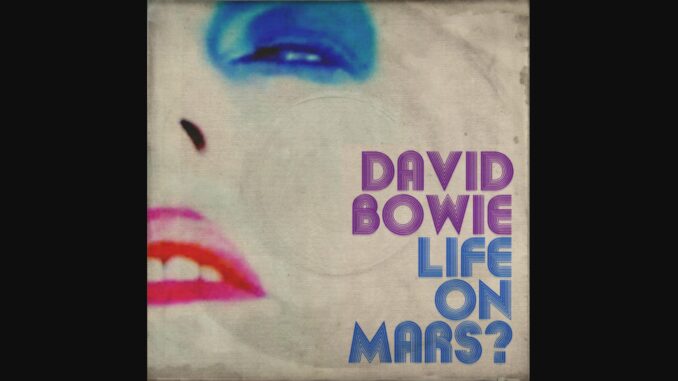
In 1968, David Bowie was in a transitional and exploratory phase as an artist. He was still largely unknown to the mainstream, but had laid the groundwork for his future breakthroughs. He has released his self-titled debut album in 1967 and was already shifting away from the whimsical pop it represented towards more introspective and narrative-driven songwriting, some of which would appear on his next album Space Oddity in 1969.
It was during this time, in early 1968, that Bowie was contacted about a job. He was under contract with Essex Music, run by David Platz, who wanted him to write an English version of the French song Comme d’Habitude.
Why Bowie? There may have been some element of chance. Platz wanted to adapt the song for the English market, and Bowie was one of his contracted songwriters, despite being relatively unknown at the time.
Bowie duly submitted a set of lyrics for the song, but nothing came of it. A bit later, though, he heard the song on the radio with a whole different set of lyrics. That’s when he understood that his work had not been used.
In an interview with Michael Parkinson in 2002, Bowie recalled the experience: “I wrote some really terrible lyrics [to it]. I think I called it Even A Fool Learns To Love. I sent it back again and I thought that will be the last I hear of that. Then I hear it on the radio and I thought ‘That’s that tune, it must be my song … but hang on, these are different lyrics,’ and it was Sinatra singing My Way.”
That’s right – Bowie had submitted one of the candidate lyrics for the ultimate showtune evergreen that we now know as My Way, and been rejected. They had gone for the version written by Paul Anka.
Bowie told Parkinson that hearing My Way and realising his rejection both angered and inspired him. “That really made me angry for so long – for about a year,” he said. “Eventually I thought, ‘I can write something as big as that, and I’ll write one that sounds a bit like it.’ So I did Life On Mars?, which was my sort of revenge trip on My Way,” Bowie said.
It is almost ironic that such a beautiful song was born out of feelings for revenge, but even negative emotions can inspire something new, uplifting, and amazing.
The song itself starts quietly – just a single piano note, followed by a rest, before Bowie starts singing on the third beat. The chord sequence of My Way is used for the song’s opening bars. The bass comes in at the lyric “sunken dream.” Instruments begin to build at the pre-chorus; strings and bass crash on the downbeat, continued by an impressive run of chords on piano while the intensity of Bowie’s voice grows, changing the key several times. The final climax is reached at the word “Mars“, which is a B note Bowie holds for three bars. Another sequence plays before the next verse begins. Things have calmed, and we start the journey anew.
Thematically, the song can be taken as pure escapism, although a lot more is more going on. A lot of the song is abstract, thought the basis of the song is about a girl who goes to watch a movie after an arguments with her parents. When real life makes you sad, there are a number of ways to escape it by engaging in a fantasy. The movie that the girl is watching ends with the line “Is there life on Mars?” on the silver screen.
It’s a God-awful small affair
To the girl with the mousy hair
But her mummy is yelling, “No!”
And her daddy has told her to go
But her friend is nowhere to be seen
Now she walks through her sunken dream
To the seat with the clearest view
And she’s hooked to the silver screen
But the film is a saddening bore
For she’s lived it ten times or more
She could spit in the eyes of fools
As they ask her to focus on-Sailors fighting in the dance hall
Oh man!
Look at those cavemen go
It’s the freakiest showTake a look at the lawman
Beating up the wrong guy
Oh man!
Wonder if he’ll ever know
He’s in the best selling show
Is there life on Mars?
David Bowie described the song as “a sensitive young girl’s reaction to the media,” adding “I think she finds herself disappointed with reality… that although she’s living in the doldrums of reality, she’s being told that there’s a far greater life somewhere, and she’s bitterly disappointed that she doesn’t have access to it.”
Bowie jotted down these quotes on hotel stationery, later published in a U.S. trade advertisement for the Hunky Dory album. His commentary frames the song as a surreal yet poignant critique of media-fed dreams and societal disappointment, echoing the song’s lyrical collage of absurdity, escapism, and existential frustration.
The song’s title question – “Is there life on Mars?” – isn’t literal. It’s a cry of frustration from a girl who feels alienated from the world around her.
Life On Mars? was written during a period in Bowie’s early career where several songs revealed a deep fascination with space, as demonstrated on Space Oddity, Starman, The Man Who Fell To Earth, Moonage Daydream, Hello Spaceboy, Born In A UFO, and of course Life On Mars?. Bowie also created the alter ego Ziggy Stardust and the band Spiders From Mars, becoming pop culture’s supreme alien.
The interesting thing is that space can be a metaphor for isolation, alienation, and identity, which we see in a lot of Bowie’s space-themed songs. Life On Mars? features one of Bowie’s most layered uses of space as metaphor, reframing cosmic imagery not as escapism, but as emotional critique.
In Bowie’s song, Mars is used as a symbol of unreachable possibility. His question “Is there life on Mars?” becomes a cry of existential frustration, suggesting that the promises of media and society feel hollow and unreachable. Mars becomes shorthand for a better, more meaningful existence that’s forever out of reach.
Unlike Space Oddity, where Major Tom drifts into literal isolation, Life on Mars? keeps its feet on the ground. Bowie’s use of space here is more ironic and poetic than sci-fi: Mars isn’t a destination, it’s a question. A symbol of hope, disappointment, and the unreachable.
When the girl in the song retreats into the surreal world of cinema after a fight with her parents, she finds that “The film is a saddening bore / For she’s lived it ten times or more.” While humanity looks outward for meaning, the song suggests we’ve failed to find it here on Earth.
This is really the crux of the song. Life on Mars? doesn’t ask whether there’s life on another planet – it asks whether there’s meaning in the one we’re stuck on. Bowie’s genius lies in turning space into a mirror, reflecting our own emotional and cultural voids.
Writing the song came easy for Bowie. In a 2008 interview with Mail On Sunday, Bowie recalled: “This song was so easy. Being young was easy. A really beautiful day in the park, sitting on the steps of the bandstand. […] I took a walk to Beckenham High Street to catch a bus to Lewisham to buy shoes and shirts but couldn’t get the riff out of my head. Jumped off two stops into the ride and more or less loped back to the house up on Southend Road. Workspace was a big empty room with a chaise lounge; a bargain-price art nouveau screen (‘William Morris,’ so I told anyone who asked); a huge overflowing freestanding ashtray and a grand piano. Little else. I started working it out on the piano and had the whole lyric and melody finished by late afternoon. Nice.”
Two people that would end up having a massive influence on the song’s final expression was Rick Wakeman and Mick Ronson. Bowie continues: “Rick Wakeman [of prog band Yes] came over a couple of weeks later and embellished the piano part and guitarist Mick Ronson created one of his first and best string parts for this song which now has become something of a fixture in my live shows.”
Bowie recorded a demo of Life on Mars? in June 1971, which was finally released to the public in November 2022 as part of the Divine Symmetry: the Journey to Hunky Dory deluxe box set. The demo is one minute and fifty-three seconds long, and has Bowie alone on vocals and piano.
This early demo contains only the first verse and chorus, and several lyrical variations from the finished track, including “It’s a simple but small affair”; “Her mother is yelling no, and her father has asked her to go”; and “It’s a time for the lawman beating up the wrong guy.”
The version of Life on Mars? that we all know and love was recorded on 6 August 1971 at Trident Studios in London, co-produced by Bowie and Ken Scott. As it happened, that was the final day of the Hunky Dory studio sessions. According to Bowie biographer Chris O’Leary, Bowie and Scott considered the track to be ‘the Big One’ and purposefully saved it for the end of the sessions.
Bowie’s backing band consisted of guitarist and string arranger Mick Ronson, bassist Trevor Bolder, and drummer Mick Woodmansey. Rick Wakeman of Strawbs (and very soon, Yes) was called in as a session player to provide piano, having already worked with Bowie by providing mellotron on Space Oddity.
In a 1995 interview with Keyboard Magazine, Wakeman said he met with Bowie in late June 1971 at Haddon Hall. This is where he first heard demos of Changes and Life on Mars? in “their raw brilliance“. He went on to say that the songs were “the finest selection of songs I have ever heard in one sitting in my entire life” and that “I couldn’t wait to get into the studio and record them.”
The piano used by Wakeman was the same 1898 Bechstein that was used by the Beatles for Hey Jude, and later by Queen for Bohemian Rhapsody. Wakeman continues, “I remember leaving [the studio] and saying to a couple of friends that I met that evening in a local pub that I’d just played on the best song that I’d ever had the privilege to work on. It had every single ingredient.”
The song is primarily a glam rock ballad with elements of cabaret and art rock. It has a complex structure with chord changes throughout. It is also no surprise that the string arrangement frequently receives praise – it is more surprising to learn that this was the first string arrangement Ronson had undertaken.
The band’s drummer Mick Woodmansey spoke with NME in 2016 about the recording of that very song as part of a tribute feature after Bowie’s death. In speaking about the string arrangement, he said that Ronson “was very nervous about it. We had a whole string section at Trident with the proper BBC session players who, if one note was not written properly, would turn their noses up and you wouldn’t get a good sound out of them. So Mick was really nervous, but when they played the parts they realized these rock’n’rollers might not be guys we want to be in the studio with, but the parts are good. They took it on and really went with it.”
In the BBC documentary David Bowie: Sound and Vision (2002), Mick Ronson’s wife Suzi humorously recalled that Mick was so nervous about arranging a score for a full string section that he retreated to the bathroom at Trident Studios to work out the parts in solitude. Of course, he nailed it in the end.
Speaking about nailing it: Bowie recorded his vocal performance for the track in one single take. Regarding Bowie’s talent as a vocalist, Bowie’s co-producer Ken Scott later stated in his own memoir Abbey Road to Ziggy Stardust (2012): “He was unique. [He was] the only singer I ever worked with where virtually every take was a master.”
Life On Mars? would become one of Bowie’s signature tracks. It was included on the Hunky Dory album, released on 17 November 1971. The album’s liner notes included the phrase “Inspired by Frankie” next to the song in the track listing, giving a final nod to the song that had started the creative process.
The track was done and everybody believed in it, but it would take nearly two years before it was released as a single. Only at the height of Bowie’s fame as Ziggy Stardust in the summer of 1973 did RCA Records release the single in the UK. It peaked at #3 and remained in the charts for 13 weeks.
Why the delay? It seems strange today, but as it turned out, the record company may have done the right thing in holding it back.
It is hard to imagine today, but Hunky Dory was a commercial failure when it was released, only selling about 5000 copies in its first quarter. The album didn’t chart anywhere and disappeared from the public consciousness very quickly. Changes was picked as the initial lead single and released in January 1972. The label saw it as a more accessible introduction to Bowie’s evolving style, as it was an upbeat art-pop song with a catchy chorus and stuttering hook (“Ch-ch-ch-changes”). That one is also a Bowie classic today, but that single failed, too.
What to do next? The label were cautious about putting out a more theatrical, string-laden track like Life On Mars? until Bowie had a stronger commercial foothold. They did not want that song to fail. After the failure of the initial album and single release, activities were paused while they went back to the drawing board. The label did not give up on the song – they were simply biding their time. And on this occasion, history shows that they did the right thing. Bowie had already started talking about his new Ziggy persona, and the song seemed like it would fit that era well.
Don’t you miss the time when the record labels were playing the long game with their artists?
When the single was finally released on 22 June 1973, photographer Mick Rock (who had just shot the covers for Lou Reed’s Transformer album and Queen’s Queen II) filmed a video to promote the song. It was shot backstage at Earls Court, London, and shows Bowie in make-up and a turquoise suit performing the song against a white backdrop.
Bowie frequently performed Life on Mars? live in concert throughout his career, and the song has appeared on numerous compilation albums. The song’s original co-producer Ken Scott remixed the song in 2003 and 2016, the latter being a “stripped down” mix.
Just like the song was remixed and updated, Mick Rock ended up producing two more versions of the video. The first one appeared around 1983-84 for broadcast and compilation use, after Bowie had successfully reinvented himself for that decade with huge hits like Let’s Dance and China Girl. The original 1973 film was overexposed and colour-desaturated, removing crowd scenes and giving Bowie a ghostly, glamourised appearance. This became the de facto official version by the mid-1980s, especially as it was used in TV retrospectives and low-definition VHS releases.
Rock later expressed regret over the bleaching, noting that it obscured the visual clarity and emotional nuance of the original footage. He redressed this in 2016 when the Parlophone label commissioned him to do a new edit. On that version, he restored the original colour grading, synced the video to match the full-length 2016 mix of the song, and included outtakes and the unfaded ending with Mick Ronson’s voice. “The new version is my favorite, because there are all kinds of things you can do technically, including playing around with the colors and lots things,” Rock told Songfacts in July 2016.
The song has become a standard and an evergreen. A multitude of artists have covered it, ranging from Barbra Streisand to Lorde, Nine Inch Nails, Aurora, Fall Out Boy, and The Flaming Lips. It has also inspired all kinds of media in general, with the BBC television series Life On Mars being named after this song. The list of other TV programmes and movies that have included Life on Mars? is too extensive to get into here.
When David Bowie passed on 10 January 2016, just two days after his 69th birthday and the release of his final album Blackstar, tributes were coming in from all over the world. Life on Mars? was frequently chosen as a tribute to the artist.
One of the most poignant tributes came from Rick Wakeman, who was quick to cite Life On Mars? as one of the finest songs he had ever had the privilege of being involved with. He performed a solo piano performance in the BBC Radio 2 studios on the same Bechstein grand piano used in the original 1971 recording at Trident Studios. The performance went viral and was praised for its stripped-down intimacy and Wakeman’s expressive playing.
Wakeman always believed the song showcased Bowie’s strengths as an artist. “The great thing about David was he was a wonderful melody man, but it wasn’t just the melodies. He had great ideas for chord structures and would always throw in the odd surprise when you were least expecting it.”
Facebook Comments