
Some songs are timeless. The classic rock band format of vocals, guitars, bass, and drums has been fashionable since the late 1950s, and found an expression in the 1970s that still sounds current. New tracks are released today that stylistically could have been written and recorded 50 years ago, and vice versa. The main difference is usually more about sonics and sound quality, although plenty of bands go to great lengths to emulate vintage sonics.
Other songs are less timeless – still worthy, but very much sounding like the times they were made in. Production values that are popular at a given time can place a song within that specific timeframe. This can make it sound dated after a while, but it can also tap into a nostalgia thing and become a cherished time machine. But still, of its time – not timeless.
1980s heavy metal is very interesting from this perspective. Plenty of songs from the 1980s is still timeless, but it was also an era with musical trappings. The big choruses. The layered use of keyboards and synths – and dated synth sounds. Electronic drums. The reverb. Focus on the hummable chorus. The emergence of the power ballads. The introduction of hairspray as one of the most important tools of the decade.
These days, several bands take advantage of this, creating music specifically to sound like it comes from, say, the 1980s. Bands like Night Flight Orchestra and H.E.A.T. have had great success with that formula, bringing back 1980s-styled melodic rock with big choruses, cheesy keyboard layers, and specific song arrangements. They are still doing it on their own terms, though. This brings us to the heart of the matter.
In the 1980s, many hard-working, honest, nitty-gritty metal bands found themselves being pushed in this direction against their will by their record labels and management. They saw the success of bands like Def Leppard and Bon Jovi, who “prettied up” and started writing more radio-friendly and lighter material with strong melodic hooks and big choruses. We also saw Twisted Sister make cartoonish music videos that became must-see and took that band to the next level as well. If these things could take these bands to the stratosphere, clearly that same formula would also elevate others. Right?
The insanity went so deep that the label thought this would even work for Raven.
Raven is an English heavy metal band, formed in 1974 by John Gallagher (vocals, bass) and his brother Mark (guitar). In the best Spinal Tap tradition, the drummer position has fluctuated over the years, but Rob “Wacko” Hunter was the drummer from their first album in 1979 until 1987. Up until 1980 they were a quartet, but the second guitarist position fluctuated wildly as well, and they eventually settled on being a trio.
The band’s sound was always rooted in British hard rock, with highly energized live shows and interaction between band members developing a unique image and style of play, described as “athletic rock”. For a while they began wearing guards, helmets, and plates from various sports (hockey, baseball, etc.) and incorporating them into the playing of their instruments. After a while, a lot of this was ditched, although Wacko would retain the hockey mask.
By their first album, their music developed into a unique amalgam of speed and power, heavily influencing the genres of speed/thrash metal and power metal. This style is prevalent on their first three albums, which were released on Neat Records – a low-budget metal label based in Newcastle, England.
Each album was more successful than the previous, and after releasing their third album All For One in 1983 they went on their first headlining tour of America with Anthrax and Metallica opening for them. Chew on that one for a bit – Anthrax and Metallica, two of the so-called ‘big four of Thrash Metal’ – opening for Raven! Those bands were just starting out, obviously, but it still says something about Raven’s position around that time.
Several labels took note of Raven, with Megaforce founder/manager Jon Zazula believing they were major-label material. After releasing a live album in 1984, and contributing songs for movie soundtracks, Atlantic Records managed to sign the band to a worldwide contract. The band were eager to take the next step, moving their permanent base from Newcastle to New York City.
Sadly, the Atlantic years would prove to be less than stellar for the band. The label who had been keen to sign them for their existing strengths quickly felt that a shift to a more commercial direction would benefit the band. This shift was moderate on their fourth studio album Stay Hard (1985), which became a minor hit on the strength of the single and video On And On.
Things would get a lot more drastic when the band went back into the studio to record The Pack Is Back in 1986.
Mark Gallagher confirms this in an interview with the Defenders of the Faith website: “We weren’t as happy overall with the sound [on Stay Hard] as we’d been on All for One, but it still sounded good and we liked the songs. The album we had the problem with and there was a lot of pressure to be commercial was the next one, The Pack is Back.”
The band and label talked to several producers about doing the album. John Gallagher reveals in the liner notes for the Atlantic Years box set that one of them was Gene Simmons from KISS: “Johnny Z kept a copy of the phone call where he was like, ‘Well, these guys can’t write a song to save their lives, but luckily, you’ve got me. I can write the whole album. I’ll just need $100,000 to get started on the project.’ It was like, ‘Ye-ah? See ya, bye!'”
In the end, the band ended up with the legendary producer Eddie Kramer. Kramer was not known as the type of producer who would come in and have much song production input, but he was well known for his excellence in capturing bands as they naturally sounded live. This had given him particularly strong reputation as a live album producer/engineer, having recorded Jimi Hendrix’ Woodstock and Fillmore East live albums, Alive! and Alive 2 by KISS, Led Zeppelin’s The Song Remains the Same, and the live album series from the 1969 Woodstock festival just to name a few.
Raven naturally hoped that Kramer would be able to record an album that sounded more like their live shows. The Stay Hard album had veered away from that. They did not know that The Pack Is Back would move even further in the opposite direction.
Before we continue, it must be said that The Pack Is Back is not a bad album. It is just not very representative of Raven as they had been, or as they would become again. For a while in the mid-1980s, Raven became a 1980s-styled heavy metal band in every sense of what that entails. Several songs made a pretty good stab at that.
In hindsight, it is an interesting experiment. And, as mentioned initially, it has become an album that perhaps more than any other Raven album is able to transport this writer back to those times, especially as The Pack Is Back was the first Raven song I ever heard.
My 15-year-old self could not believe how incredible this track sounded back then. I had no context to the band whatsoever. They sounded like a perfectly valid 1980-style metal band to me. I brought the album to a listening station in a record shop based on the cover image alone (and we’ll talk about that cover later!). The needle hit the grooves, and as it happens, the title track is the first track on that album.
The Pack Is Back is a huge song on the album. It always felt like the type of song a band would write as a show starter, becoming an anthem describing the gathering of the faithful, and the power that the union can provide. The track starts with a steady, somewhat tribal drum pattern, adds some initial guitar riffage, after which the initial lyrics are sung over the continuing tribal drum pattern.
Here we are, what are we doin’?
Take a look, what do they want?
So much for an easy livin’
We just wanna SCREAM!Matchstick woman, matchstick man
Individuality down the drain
Baby – take that tan
Pleasure and pain
Don’t you know what you can do
When it’s only up to youOpen your hearts and shout it (hey)
You’ve gotta stand up and be counted
Open your arms and shout it
The pack is back
Open your hearts and shout it
You’ve gotta stand up and be counted now and forever more
The pack is back!
For better or worse, the song is nothing less than a bona fide 1980s-styled heavy metal anthem. It celebrates the here, the now, the coming together of the likeminded – the tribe, the pack – and encourages you to stand up for yourself in what you do. Classic heavy metal tropes which don’t push any lyrical and musical boundaries whatsoever, but that might not be what a teen metalhead would be looking for anyway. And, it works. It is not particularly original, but it has attitude, coolness, and a certain reaffirming message. These factors combined will do just fine.
Some of the musical trappings of the era actually benefits the end result. Several songs feature ‘gang vocals’ where passages (typically choruses) are sung by several voices in unison, creating a nice effect similar to bands like Accept and Quiet Riot, who were known for the same thing. Elsewhere, more unusual yet strangely fascinating experiments were taking place. If you ever wondered what Raven would sound like with a horn section, The Pack Is Back is the album that provides the answer – check out the tracks Hyperactive and Don’t Let It Die.
The title of the album/song actually came from the world of sports. ‘The pack is back’ is the slogan of the Green Bay Packers. “They were like a gang, and we were like a gang,” John says in the Atlantic Years box set liner notes. “So that was brought up to us, and we went with it.”
There are many who like this album, but also many (including several who like it) who feel it doesn’t really sound like Raven – neither the version that had been nor the version that would be again. It remains a unique point in the band’s career.
“I think one of the main reasons for that,” said John Gallagher in an interview with Rock Daydream Nation on YouTube, “is that Rob insisted on playing to a click track. ‘I want to play with a click track, I don’t want to be put off by Mark playing the guitar.’ With the benefit of age and hindsight, the greatest things about the band is the push and pull tempo-wise between… especially back then, between Rob, who would play slightly behind the beat, and Mark who would play slightly in front of the beat. They would be playing this game of catch-up all the time, incrementally, but it’d give a sense of energy and danger and urgency. And that’s completely void [on this album]. […] Especially the medium-paced stuff on the album tends to drag because of that.”
Mark is more forgiving about specific songs – including the title track, which remains a highlight. ”It works on Rock Dogs and The Pack Is Back, where the slower rhythm… you know, the “boom boom” intro… you want it more regimented, and it works fine.“
Songwriting in Raven happens individually, with songs being a mixture between Mark’s spontaneous flashes of inspiration and John’s more structured and thought-out approach. In a 2013 interview with Songfacts, John said: “It’s a collaboration in the sense that whoever brings something to the table gets to watch it ravaged by the other two wolves. My brother’s very spontaneous. He’s the guy who’ll just sit down and off the top of his head play a song from top to bottom. […] I’m a bit more methodical. I’ll write loads and loads of riffs and then start going back, gluing this one, fit with this one, this one’ll fit with this. It’s all music, and then the music will suggest titles or phrases, and something will jive and I’ll try to work around that.”
On The Pack Is Back album, things were definitely erring on the side of carefully putting songs together. Ideas may have been born out of spur-of-the-moment spontaneity, but these ideas would be carefully structured and restructured.
“The album’s a litte more commercial,” Mark continues, “which isn’t what makes it bad. I listened to it recently, and some of the songs are good, some songs not so good. Some of the lyrics are very cheesy to me… but that album showed that we have a lot of craft. But craft is not creativity, or lightning in a bottle. Craft is, ‘I built this wall exactly, and all the bricks are perfectly lined up.’ And it was a long, painful process. We were in for about a month doing pre-production, about six weeks recording, and about six weeks mixing. One of the things we learnt is that we’d never spend that long recording again. It’s crazy. You’re getting things meticulously correct, and that’s not what it’s about. It’s not being perfect. It’s having the danger of… is it all going to fall apart at any minute? Or, where did that come from? The occasional squeaky noise where it’s not supposed to be. This is the record that taught us that – after the fact. The annoying thing was the constant push for clean guitars, big choruses, etc.”
It is still fascinating that a producer like Eddie Kramer failed so utterly at capturing the live sound of the band. He is known for capturing the bands well as they naturally perform their material, but this time, he will have gotten his own set of instructions from the label about what type of album they wanted and steered the band in that direction.
“The production values were crazy,” Mark says about this. “You have a band like us, where the live thing [highly energetic shows] is very prevalent [in our sound], then you got a producer like Eddie Kramer, who’s thing is the live thing, very much… Led Zeppelin, KISS, Hendrix… and then it’s like, ‘yeah, now go and do a Def Leppard record!’ We were just, “…what?!!” So looking back at it, it was all very… you know, “You’re a plumber! Great! We’re gonna have you do woodwork now!” Haha!”
Mark also shared some thoughts about this with Songfacts in 2013: “When it came to The Pack is Back, our idea was to do a hi-tech heavy metal album, which in a sense, it was. We got a great producer, Eddie Kramer, who made his name making live-sounding records, but here we are doing state-of-the-art nonsense with a thousand overdubs, which sucks the life out of what we do. The Raven sound is a careful balance between craziness, melody, anarchy, sensibility, structure and non-structure. This was way too far in one direction, way too commercial. Rob insisted on playing with a click track, which sucked the life out of it. It worked on a couple of songs, but on others, it didn’t. And he wrote a lot of lyrics that were cringe-worthy. Definitely Top 40 pop. We all went along with it. We were young, we were naive, and we were promised the world. And that wasn’t to be the case.”
It is understandable that the album’s creators will judge the album in terms of the pressures that was put on them, and in terms of what could have been instead. Still, as John himself says, it contains several strong tracks that work fine as they are – such as the title track – and others that could have worked with a different production.
Interestingly, John has recently become enticed by the thought of what these songs could sound like now, with a proper Raven production. “Mike, our drummer now, said ‘I’d love to redo some of those songs, for the hell of it.’ And we probably will at some point! The Pack Is Back rebooted? Yeah. That might be fun to do. At one point we’d do it, and we’d make it different.”
Rock’n’roll history is filled with stories of bands doing off-kilter albums. When a band – willingly or otherwise – leans into the prevailing tastes of the moment, the results can be fascinating, and sometimes divisive. These types of albums become musical time capsules, capturing not only the sounds but the ambitions, uncertainties, and commercial pressures of their era. These works invite reflections on the shifting boundaries of authenticity and evolution, and on what a band should be versus what they might become if swept along these currents of change. In this light, an examination of The Pack Is Back should be about more than just an exploration of sonic signatures. It provides insight into the broader dynamics between the drive to innovate, the commercial impulse to fit in, and the creative desire to stand apart, and how all of these collide.
This dynamic between timeless and era-specific music becomes especially apparent when examining albums that consciously or unconsciously embody the trends of their day. Sometimes bands – whether by choice, pressure from their labels, or a desire to experiment – veer into territory that feels distinctly tied to its moment in history. The result can be polarising: a record that stands apart in a band’s catalogue, cherished by some for its bold embrace of contemporary sounds, but critiqued by others for straying from the raw, unpredictable energy that originally defined the group.
This is now the curious legacy of The Pack Is Back – an album that, through its glossy production, mechanical tempos, and commercial ambition, captures both the allure and the pitfalls of chasing the zeitgeist. It is a snapshot of a particular musical crossroads, and it continues to spark debate among fans about what truly makes a song, or a band, feel authentic and enduring.
In the interview with Rock Daydream Nation, John putsputs a lot of this down to naivty: “We had no problem with being ‘commercial’ per se, because it is a large part of what we do – always has been and always will be. But when it’s too much of what we do, you end up with a different animal. It’s got to be tampered with that chaos, and the crazy factor. You’ve got the songwriting which is on the logical side, and then you’ve got the craziness [in performing]… you’ve got to balance these things out. That’s the recipe for our particular cake, you know. And again, hindsight looking back, much emphasis was put on this.”
And then, of course, there’s the album cover. Given that they had repurposed Green Bay Packers’ slogan as the album title, a sports theme was created where the band – as football players – are bursting out of their lockers looking mean, lean, and tougher than your daddy. All the while, they are wearing overtly tight, spandex-like clothing alongside random sports paraphenelia.
John reveals in the Atlantic Years box set liner notes that it was the label’s idea to play into the sports thing, given the Green Bay Packer slogan: “They said, ‘We’ll make you look like football players bursting out of lockers.’ We looked more like hairdressers. ‘Hey, I’ve got these straps,’ someone said. ‘I’ll wrap them around your legs. That’ll look good.’ It just looked like I was wearing my underwear on the outside.”
Until I saw that quote, indeed I always thought he was wearing his underwear outside his spandex – something not even Spinal Tap could have gotten away with. Mark is probably wearing a groin guard, but I always thought it looked like a thong. None of this helps the band sell their best tough guy poses, as they stand with shredded locker cabinet metal sheets around them. Raven have always had a sense of humour, which is the best way of approaching this work of art. This was not what they would have chosen themselves, but this is how they were directed, and they were trying to do a good job with what they’d been given.
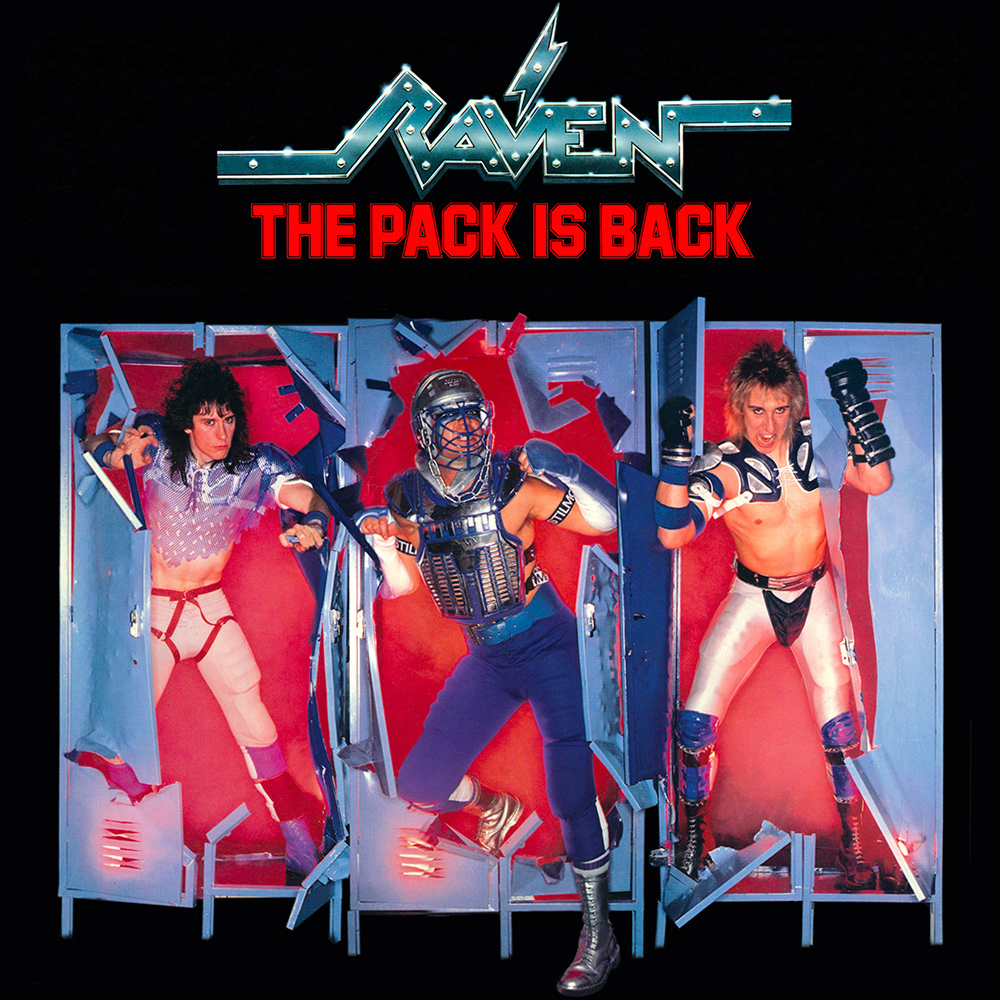
The image, captured by photographer Mark “Weiss Guy” Weiss, also includes a backdrop of a brick wall and a general mid-80s “heavy metal” aesthetic. The album credits Tony Incigeri with cover art design, and as such he is the main responsible for this amazing piece of art, which was included on a Metal Hammer infamous list of “the 50 most hilariously ugly rock and metal album covers ever” in 2023. I seriously don’t think it’s quite as bad as that – there really are a lot of ugly rock and metal album covers in the world. But is it hilarious? Humorously bad? Over the top? Yes, yes, and yes!
The Pack Is Back was released as Raven’s fifth studio album on 10 March 1986. In spite of all the effort that went into crafting nice, melodic songs with clear and professional mix that would sound good on radio, the album did not chart anywhere.
Not finding any natural candidates for single release amongst the bands self-penned material, a cover version of Spencer Davis Group’s Gimme Some Lovin’ was recorded and released as the lone single from the album. It felt like the label had limited faith in their own creation, though.
“We were all set to record a wonderful video with NFL Films,” John told Songfacts. “We went to the facility in Jersey, met all the guys, had all these great ideas. It wasn’t an outrageous amount of money we asked for the video, but the record company said, ‘Nope. We’re not giving you that.’ ‘Really?’ They basically dressed us up as clowns and then refused to support that.”
The band went on a tour in support of the album, but knew there had to be a change. If the change of direction yielded zero fruits for the band, they would rather make the music on their own terms. They went back into the studio just months after the album had been released to record five new songs – written, produced, and recorded on their own. They were released as the Mad EP in July 1986, just four months after The Pack Is Back. These songs mark the return to a more aggressive and metallic sound, and the band never compromised on their own sound again.
“We had a major re-think at that point,” John told Songfacts. “We decided, the hell with you guys. We did the Mad EP [released 1987], which was definitely a return to form, and then following that, the Life’s a Bitch album, which was one of the better ones we’ve ever done. Straight back to our mission statement.”
They followed up with their sixth studio album Life’s A Bitch in 1987, which was yet another release cut from the band’s own cloth. Just like the EP, this was seen as a huge return to form. It may not have been the style of music that Atlantic was hoping for, and band and label alike were happy to sever their relationships after that.
That marked the end of an era for Raven, as Rob “Wacko” Hunter, who had played drums on every release from the band since the beginning, decided to leave the band. He was replaced by Joe Hasselvander, formerly of Pentagram, as the band signed with Combat and SVP, continuing their still ongoing adventures.
Looking back at The Pack Is Back from a distance is less dangerous than it sounds. It may have halted the band’s momentum at a time when metal was riding on its highest wave ever, but it’s not a bad album. Its biggest crime is that it might not represent the band correctly. As a mid-80s experiment, the album sits comfortably among several other releases from the likes of Ratt, Twisted Sister, Quiet Riot, and similar bands at the time it came out. If anything, the sound is rather uniform of its time, but that’s the kind of album it was meant to be.
Every song on the album has not aged equally well, but I still get a huge kick out of the title track especially. It features cool riffs, a chugging, driving rhythm, and a hugely anthemic chorus. It captures the essence of the era in every good way, with the right mix of overall flamboyance, lyrical defiance, and musical accessibility.
Facebook Comments