
The 1970s would prove to be extremely unpredictable for Iggy Pop. The Stooges broke up in 1970, got back together with a revamped line-up as Iggy and the Stooges in 1973, then broke up again in 1974 after a final gig that went down in legend as particularly rowdy. Iggy recorded an album with James Williamson (Kill City) in 1975, but it was temporarily shelved.
Iggy was worn out and at an all-time low in 1975. Unable to control his drug use, he checked himself into the UCLA Neuropsychiatric Institute in Los Angeles to try to clean up. David Bowie was one of his few visitors. The two had met and forged a friendship when Bowie was brought in to mix the Raw Power album two years earlier. Iggy later recalled to Bowie biographer Paul Trynka in 2011: “Nobody else came … not even my so-called friends in LA. But David came.”
In 1976, Bowie brought Iggy along as his companion on the Station To Station tour. This was Pop’s first exposure to large-scale professional touring, and he was impressed, particularly with Bowie’s work ethic. He later stated that he learned all of his self-help techniques through Bowie on the tour.
During this time there were further talks of Iggy recording a solo album with Bowie as producer. Bowie and his guitarist Carlos Alomar had written a new song, Sister Midnight, which Bowie offered to Iggy. Meanwhile, Bowie occasionally performed it live on the tour before it had been recorded by either of them.
After a concert at the Community War Memorial Arena in Rochester, New York on 21 March 1976, Bowie and Iggy were arrested for marijuana possession. The arrest took place at the Americana Rochester Hotel where police found about half a pound of marijuana. Bowie, Iggy, and two others were held in custody for three hours before being released on bail for $2000 each.
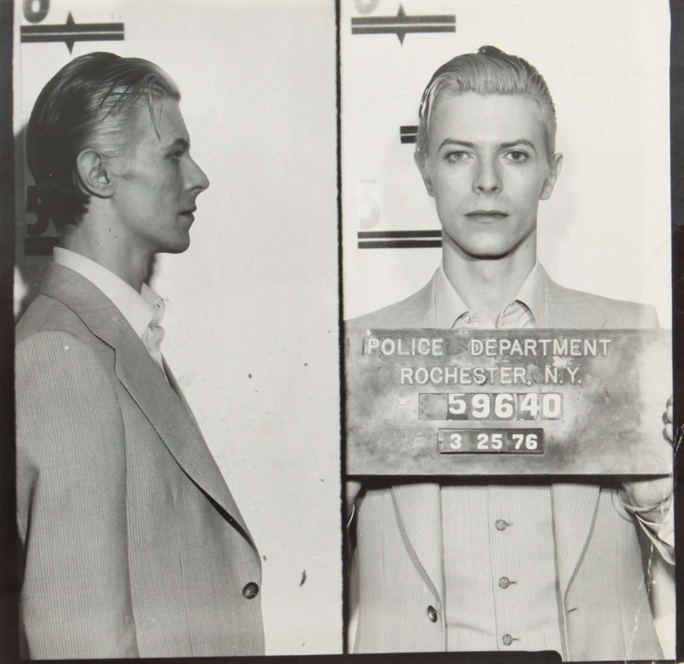
Bowie’s mugshot (possibly one of the most suave of its kind ever!) which was taken during his arrest has since become quite iconic and was even sold at an auction years later. Bowie later pleaded not guilty and a grand jury decided to pass on the case, leading the charges to be dropped. Interestingly, Bowie never performed in Rochester again after this incident.
The arrest was an important catalyst for what happened next. This was a tumultuous period in Bowie’s life and something had to happen. Just like Iggy, he had developed a drug addiction. Bowie wanted to clean up, but also to get away for a bit. Maybe the two could be combined. Iggy felt similarly, so shortly after, the two of them moved to West Berlin to escape the drug culture of Los Angeles, clean up, and focus on their music careers.
As far as cleaning up the move was only moderately successful. They later admitted that they could not resist the hedonistic nightlife the city had to offer. Musically, though, this stay would yield enormous rewards for them both.
The start was a bit bumpy. Enjoying a newfound sense of freedom, the pair indulged themselves, once driving at full speed around an underground car park threatening to crash, high as kites, until they eventually ran out of fuel. The incident’s been immortalised in the Bowie song Always Crashing In the Same Car.
All their behaviour wasn’t destructive. They took a great shared interest in art, and were particularly inspired by European styles in general and the artist Erich Heckel in particular, to the point that several of the albums they created in Berlin replicated poses from Heckel’s paintings.
RELATED ARTICLE: When David Bowie and Iggy Pop were inspired by painter Erich Heckel
In an interview with Q magazine January 2008, Iggy Pop talked about how he and Bowie still had to do the everyday things during their ‘exile’ in Berlin: “Living in a Berlin apartment with Bowie and his friends was interesting. Who did the chores? Well, I seem to remember doing a little hoovering. The big event of the week was Thursday night. Anyone who was still alive and able to crawl to the sofa would watch Starsky And Hutch.”
Once they’d properly settled into their lodgings in the Berlin locality of Schöneberg, they focused on getting back on track. Bowie did this by working with Brian Eno and moving into his next era of pop, creating one of his most famous evolution of styles as he dove from glam pop to the electronic avant-garde. This resulted in his trilogy of ‘Berlin albums’: Low, Heroes, and Lodger.
Iggy Pop, however, did not bring in an external collaborator. He wanted to work with David Bowie, and the two of them threw themselves into what would become Iggy’s first album in his own name, The Idiot. After working out the material, they relocated to France for recording sessions at Château d’Hérouville in France. The album was recorded between June and August 1976.
While Bowie composed much of the music for The Idiot, Iggy wrote most of the lyrics on the studio floor, often in response to the music Bowie was composing. Iggy was also keen to improvise some of his lyrics while standing next to the microphone, something that fascinated Bowie.
Bowie’s Low and Iggy’s The Idiot were both worked on relatively simultaneously and are in many ways sister albums. A lot of the musicians who worked on Low did double duty by playing on The Idiot as well, primarily under Bowie’s guidance. The process was fluid, with the two of them both being involved on each other’s albums – you can hear Iggy contribute backing vocals on Low, while Bowie is obviously very much part of The Idiot.
Bowie’s label RCA Records released Low in January 1977, after first having refused for some three months. They did not like the new direction of the material and were convinced it would be a commercial failure. They were of course wrong. Due to its unexpected commercial success (#2 in the UK, #11 in the US and a Top 5 single) Bowie persuaded RCA to sign Iggy Pop and release The Idiot in March, which is exactly what happened. Upon its arrival on 18 March, it became the biggest commercial success involving Pop up to that point, reaching the Top 40 in both the US and the UK charts.
Bowie declined to promote Low, opting instead to support Iggy on a tour of his own. Bowie assembled a band that included himself on keyboards, Ricky Gardiner on guitar, with brothers Tony and Hunt Sales on bass and drums respectively. Rehearsals began in mid-February 1977 with the tour kicking off by early March. Songs played included popular Stooges numbers, a couple of tracks from The Idiot, and tracks they already had written for the next album Lust For Life, including Tonight, Some Weird Sin, and Turn Blue.
Bowie was adamant about not taking the spotlight away from Iggy, often staying behind his keyboard and not addressing the audience. This remains a remarkable gesture from one of the most famous artists in the world coming out of the glam era. Live recordings from this tour would eventually be released on the album TV Eye Live in 1978.
The tour ended on 16 April. The success of The Idiot and the tour earned Iggy fame and success far greater than he ever achieved with the Stooges. However, during interviews he was often asked about Bowie more than his own work. This frustrated Iggy and led him to realise that for their next collaboration, he would have to take more control.
At the end of the tour, Iggy and Bowie returned to Berlin to start writing for their next albums. To further achieve his own identity, Pop moved out of the apartment he was sharing with Bowie and his assistant Coco Schwab, although he didn’t go far – he relocated to his own apartment in the same building.
The two continued writing for a few weeks before they were joined by guitarist Ricky Gardiner in May 1977, who would be an important collaborator for Iggy on the Lust For Life album.
Gardiner first made his mark in the music world as a founding member of Beggar’s Opera – a Scottish progressive rock band who had been active 1969-1976. Just as that band ended, he was tapped by Bowie to perform on the Low album, proving personable and versatile enough to also be invited along on Iggy’s tour.
While Gardiner recalled that “quite a few ideas were already present” when he rejoined the guys in Berlin for work as a session guitarist, he was surprised to be asked if he had any ideas. It turned out that several more songs were needed.
The first thing he thought of was a chord sequence he had come up with recently. He had been sitting under the apple blossom near his rural home in Scotland, idly strumming his guitar, when the chord sequence had appeared out of nowhere – the exact chord sequence that runs throughout The Passenger.
In The Independent newspaper 14 October 2005 Gardiner further recalled, “It was a case of the chord sequence ‘slipping through’ while I was lost in the glory of a beautiful spring morning.”
Given that The Passenger is so quintessentially urban, Gardiner’s bucolic inspiration for the riff is more than a bit ironic. The setting it first emerged in – by a field beside an orchard on a glorious spring day with the trees blossoming – could not be more different than the cold, unorganic, dark city setting it ended up describing and being associated with.
In the same article in The Independent, Gardiner also mention: “When I was invited to join David and Iggy in Berlin, I did not realize that they needed material, so I was unprepared when they asked me if I had anything.” Gardiner proceeded to play them his chord sequence on an unplugged Stratocaster.
Iggy seized on the song as soon as he heard it and, as was his habit, scribbled down lyrics on the spot. He later told The Guardian: “The Passenger was partly written about the fact I’d been riding around North America and Europe in David’s car ad infinitum. I didn’t have a driver’s license or a vehicle.”
I am a passenger
And I ride, and I ride
I ride through the city’s backsides
I see the stars come out of the sky
Yeah, they’re bright in a hollow sky
You know it looks so good tonightI am the passenger
I stay under glass
I look through my window so bright
I see the stars come out tonight
I see the bright and hollow sky
Over the city’s ripped back sky
And everything looks good tonightSingin’ la la la la la la la la
It had become normal for Iggy to prepare only fragments of lyrics before singing new vocal tracks in the studio, to the point where parts of his songs were essentially improvised at the microphone, although he would have a general idea of where he wanted to go. If things went wrong, you could always try again, but Iggy found that this approach focused him and gave raw, real results. Most takes would be used as they were.
Bowie had already been fascinated by Iggy’s spontaneous lyrical approach during the making of The Idiot. Seeing once again how well this worked inspired him to improvise a lot of his own words in similar fashion on his next studio album Heroes (1977).
Several things have been said to make up the background and inspiration for the lyrics in the song. It starts with the imagery that Iggy got from the guitar line itself. To him, its sprung rhythms summoned up the hypnotic, mesmeric experience of travelling around – whether in Berlin at night or elsewhere, in Bowie’s car or on the city’s S-Bahn overground Metro system. With no car of his own, or a driver’s licence, Pop was a perpetual passenger.
Iggy conjured up the impressions and the experience of being transported through a nocturnal metropolis, rapt at the wonders laid out before him. Trapped in his vehicle (“I stay under glass”), he drank in the sights, thrilling at the stars in “the bright and hollow sky” above.
Pop mentioned several times that he had also been inspired by the Jim Morrison poem The Lord, which compared the journey of life to a car journey. Lines like “We’ll see the city’s ripped backsides” was a direct steal from that poem. The ‘backside’ being the less glamorous parts of the city, referring to a continually moving picture of never-ending windows, signs, streets, buildings, and all sorts of people.
Yet Iggy Pop doesn’t really do passivity. Coiled into the passenger seat, his sense of personal exceptionalism convinced him that the theatre of life unfolding around him was for him, and him alone: “So, let’s take a ride and see what’s mine!”
The “La la la la la la la la”-chorus is euphoric and carefree. The passenger is not troubled, and we’ve already established that “everything looks good tonight.” He is fascinated by what he sees and continually observing.
The chorus is primarily notable for David Bowie’s backup vocals, as he is quite high in the mix during the repeated la-la’s.
German photographer and Iggy’s former partner Esther Friedman brought up the song in a 2013 interview with German magazine Zeit, saying “The Passenger is a hymn to the Berlin S-Bahn. During his time in Berlin, he made a trip on the S-Bahn almost every day. The trips gave him inspiration to write the song, especially the route out to Wannsee.”
“In Berlin,” Friedman added, “he was able to sit down in the neighbourhood pub next door undisturbed. He loved it!” This was apparently a little harder for Bowie to do.
The music flowed as quickly as the lyrics, with both often being composed and written more or less on the spot. It was quickly recorded as well, meaning Iggy would have to race to write words for songs that were being laid down in an incredible tempo.
“The writing progress was, Jesus, almost like scream therapy,” says guitarist Carlos Alomar in the book accompanying the Iggy Pop box set The Berlin Years. “Trying to emote those kind of lyrics and words – sometimes an artist is not ready for a band to knock out three songs in one session, and that was the way we worked. So just like David, Iggy started getting into this area of ‘Holy smokes, they’ve already finished three songs; I’m gonna finish my album in a week and I haven’t written a word!’ But quite honestly, I think that’s wonderful. If Iggy Pop can’t be raw, there’s something wrong with the world.”
Having spent a small number of weeks writing and arranging material. they moved to the Hansa Studio by the Wall at the end of May to begin recording. The rhythm section of Hunt and Tony Sales that has been on the tour returned, and guitarist Carlos Alomar who had also been part of The Idiot sessions was brought in by Bowie as a musical director.
As things were going well and Iggy wanted to be more in control of the results, Bowie reduced his role on Lust For Life significantly from The Idiot, often solely contributing keyboards like on the tour. Gardiner recalled that because they were already a tour-hardened band, there was a more ‘live’ feel to the new tracks than had been the case on The Idiot.
The sessions were loose, focused, fast, and fun. For the impromptu Fall in Love with Me, the band even swapped instruments: Hunt played bass, Tony Fox played guitar, and Gardiner played drums. That became the take.
Iggy, Bowie, and producer-engineer Colin Thurston shared the production credits for Lust for Life under the pseudonym Bewlay Bros., named after the final track on Bowie’s 1971 album Hunky Dory.
Iggy did not sleep much during its making, commenting “See, Bowie’s a hell of a fast guy … I realized I had to be quicker than him, otherwise whose album was it gonna be?” He worked frequently with the Sales brothers and Gardiner, taking charge of his own project to such an extent that he even rejected some musical arrangements Bowie provided him for a few tracks, including Success.
According to legend, the entire album was written, recorded, and mixed in eight days, starting in May and finishing in early June. Iggy reiterates this in the 2004 book Gimme Danger: The Story of Iggy Pop by Joe Ambrose, where he says “David and I had determined that we would record it very quickly, which we wrote, recorded, and mixed in eight days. Because we had done it so quickly, we had a lot of money left over from the advance, which we split.”
Lust For Life was launched into this world on 9 September 1977. It received little promotion from RCA, primarily due to the death of Elvis Presley just one week later. RCA was Presley’s label, and upon his death, every possible resource at their disposal was channelled into re-releasing as much of Presley’s back catalogue as possible. Although RCA had pressed decent quantities of Lust For Life ahead of this, there was no immediate capacity or focus on pressing further copies once the first pressings had sold out. It is ironic that the most overtly commercial album of Iggy Pop’s career, and the record that marked his return to health and happiness, received little to no promotion and press coverage, stifling its potential performance at the time.
In spite of all this, the album still managed to peak at #28 on the UK album charts. It remained Iggy’s highest charting release in the UK until 2016’s Post Pop Depression which went all the way to #5.
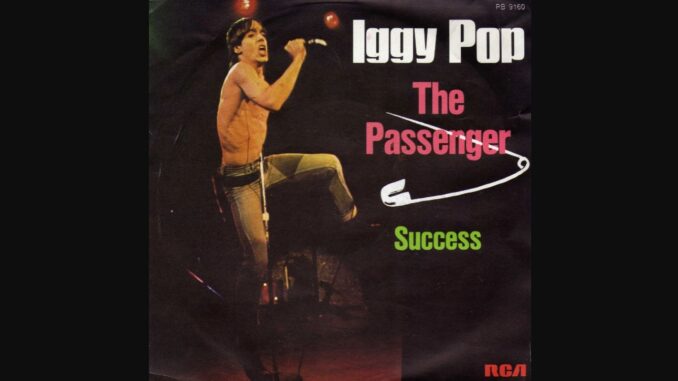
Only one single was released from Lust For Life. In most universes, a stone-cold classic like The Passenger would have been a shoo-in, but RCA inexplicably declined to use that track as a single. They wanted Success instead but agreed to use The Passenger as the B-side. That single was released on 29 August 1977, but sadly, the A-side did not live up to its name and no chart entry for it is registered anywhere.
The two Berlin albums are still Iggy Pop’s two most acclaimed albums as a solo artist. “Artistically, I really like those two records, The Idiot and Lust for Life,” Iggy said. “But I was personally just miserable… David was a really good friend to me in many ways, but… he had his whole thing going on and a whole apparatus of people around him, and problems that he had to face. For more than year, I lived in the room next door, and I had a good friendship, but it wasn’t the same as being in a band.”
As guitarist Carlos Alomar said of Pop’s excursion with his renegade pal to Berlin: “David went to Berlin with Iggy for isolation. It was to humanise his condition, to say, ‘I’d like to forget my world, go to a café, have a coffee and read the newspaper.’ They couldn’t do that in America. Sometimes you just need to be by yourself with your problems. Sometimes you just wanna shut up.”
Among the songs Iggy and Bowie wrote together for Iggy’s albums were China Girl, Tonight, and Sister Midnight, all of which Bowie performed on his own albums later (the last being recorded with different lyrics as Red Money on Lodger). Iggy is still grateful that Bowie recorded his cover version of China Girl in 1983, just as Iggy took an extended time-out of nearly three years to clean up and organise his life once and for all. The song was a global hit, and the royalty checks was more than enough to keep him going.
The Passenger would not be denied, though. The song got to #41 in the UK charts in 1987 when Siouxsie & The Banshees released their brass-tinged cover version as a single. Iggy’s profile was significantly raised after his songs had been prominently featured on the Trainspotting soundtrack in 1996, leading Toyota Avensis to use The Passenger on their new TV advert. It proved so popular that the song finally got its long overdue single release in 1998. It made it all the way to #22 in the UK charts – not bad for a 21 year old song!
Given that Iggy Pop and Siouxsie Sioux had both contributed to keeping the song in the charts since its release, it was both touching and fitting that they teamed up in 2024 to re-record The Passenger for a Magnum ice cream commercial. The ad takes viewers on a train ride with a woman indulging in a Magnum bar. The new version of The Passenger, featuring Pop’s signature gravelly vocals alongside a verse delivered by Siouxsie, is heard in the background. This was Siouxsie’s first new recorded music in nine years.
The Passenger has remained a mainstay of Iggy Pop’s live performances since its inception, and as grateful as Iggy has always been for Bowie’s help and contribution during the Berlin years, it must be satisfying that his biggest song coming out of that era had nearly nothing to do with him. Gardiner’s guitar track is obviously huge, but at its core this is an Iggy Pop song through and through. It is likely the one he will be remembered for. That is only fitting for a song about a journey that never ends.
Facebook Comments