
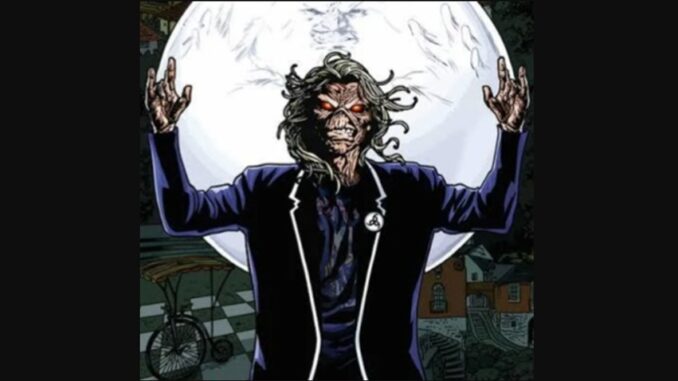
Iron Maiden may not have been sure of this themselves at the time, but they were going from strength to strength for the first half of the 1980s. 1982 was in particular a pivotal year, as they went to the drastic step of replacing their frontman Paul DiAnno with Bruce Dickinson. DiAnno was extremely popular amongst the Maiden faithful, and Dickinson was a very different type of singer. Looking back, there’s no doubt it was the right thing to do, but at the time, the band felt like they had their backs against the wall. They had something to prove.
After some successful shows with Dickinson which removed all doubt, producing a killer album was next on the agenda. They needed to show that they could produce something worthy of living up to, let alone surpassing, their first two albums – the self-titled Iron Maiden (1980) and Killers (1981). They all knew it was important to give the new line-up their own songs that pointed the way towards their future. How did they respond? Only by writing and recording one of the biggest metal albums ever: 1982’s The Number of the Beast.
One of the tracks on the album is called The Prisoner. This is also the title of a 1967 TV show created by and starring Patrick McGoohan. The band were all fans of that show, with Steve Harris and Bruce Dickinson in particular obsessing about it, quickly bonding over their common ground. Perhaps it was inevitable that the show would go on to inspire a song at this specific point in time.
As the decade would show, Iron Maiden were always happy to include a song on every album based on a fictional work that they admired. They had already written about The Phantom of The Opera on their debut album. They would go on to create songs about Dune (To Tame A Land, on 1983’s Piece of Mind), Samuel Coleridge’s Rime of the Ancient Mariner (on 1984’s Powerslave), as well as creating a whole epic epos about the life and death of Alexander the Great (on 1986’s Somewhere In Time). After seeing Braveheart in the mid-90s, the band created The Clansman (on 1998’s Virtual XI). They would continue to dip into these types of inspirations whenever inspiration struck.
The Prisoner was one of the very first genuine cult TV shows, debated and obsessed over by faithfuls who arranged fan meets very soon after the last episode had been shown. Patrick McGoohan plays a high-ranking official dealing with important secrets. It is never explained what this role is – it could be a spy (many feeling it was a thematic jump-off point from his previous spy show Danger Man), a high-ranking government official, or someone with access to vital information.
The show starts with an intro sequence which is always repeated in every episode. Set against the show’s intro music, we see the unnamed main character (McGoohan) driving down a road, making it into London. He heads down into an underground parking complex, walks urgently down a long underground corridor before ending up in an office. We see him deliver an angry tirade, which ends with him handing in his resignation. The intro music is still playing. He leaves for home, looking more relaxed at this point. He starts packing for a holiday, but his apartment is gassed and he passes out.
He awakes in The Village. He has no clue what type of place this is, where it is located, or who anyone else there is. It turns out that The Village is a glorified jail. Everything seems normal on the surface, but it is impossible to escape. Some are inmates, others are guardians, and it is never clear who is which. Nobody has a name, everybody has a number. McGoohan’s character is Number Six. The Village is led by Number Two. The identify of Number One is unknown. Likewise, it is unknown which organization or country is behind the concept of The Village – i.e. who is keeping 6 and other people prisoner there.
Number Six is brought to The Village to tell Number Two about the reasons why he resigned. He refuses to answer. Over the course of the series, we see The Village’s numerous (and sometimes quite elaborate) attempts to break Number Six’s spirit, his numerous attempts to escape, as well as trying to figure out what’s going on and/or to bring down the system from within.
The premise of the show was wildly ahead of its time and few viewers at the time understood it. No other show was remotely like it, and it still feels very unique conceptually. Few people were able to accept the end to the series, primarily because the point went right over most people’s heads. That includes the BBC executives, who felt they had to publicise a letter of apology to the public about how the show ended. That debacle is however a whole other story – suffce to say, the show would redeem itself over time.
When usenet discussion groups appeared during the early days of the internet in the early 1990s, the group dedicated to The Prisoner had by far the most discussion in it of any TV or movie group. People finally had a platform to discuss and share understandings of the many layered meanings, motivations, and plot points of the show. And did they!
The guys in Iron Maiden adored the show, and their own song paying tribute to it would be an important part of the upcoming The Number of the Beast album. They desperately wanted to open the song with some of Patrick McGoohan’s opening narration from the show. As the holder of the rights to his own work, they would have to ask Patrick McGoohan directly for permission.
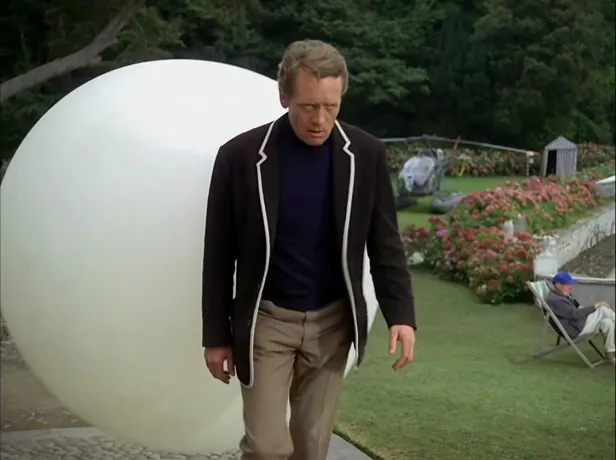
Patrick McGoohan was known as a razor-sharp, intense, driven, and headstrong chap, much like his character in The Prisoner show. He had always protected his legacy fiercely, taking great care with where and how his works would be used. There was no conceivable reason that he should give his permission for the dialogue to be used in a heavy metal song. Then again, there was nothing to lose. If you don’t ask, certainly nothing will happen.
The prospect of calling up McGoohan was so intimidating to everybody that the job quickly fell to the manager. “It was time for him to earn his keep!,” Harris quipped later on.
The band’s manager was – and continues to be – Rod Smallwood. He’s a real old-school manager from the no-nonsense school of managing, hardly intimidated by anything. This, however, was very, very different. Calling McGoohan was not just a big deal. It was mind-numbingly massive.
When the evening came to place the call, the band gathered around in the manager’s office. Nobody wanted to miss this monumental moment. Meanwhile, the manager was uncharacteristically terrified, looking positively star-struck as he nervously dialled the phone
“Oh, bloody hell,” Smallwood moaned later in Mick Wall’s authorized Iron Maiden biography. “It’s all right dealing with these arsehole rock stars, but he’s a bona fide superstar actor. I was fucking terrified!”
The rest of the band watched, grins on their faces as Rod said his hellos and hesitantly began explaining the details to McGoohan, who was speaking from his home in Los Angeles. After a bit of rambling from Smallwood, the line went quiet. After what seemed like an eternity, McGoohan asked “What was the band’s name again?” “Iron Maiden,” Smallwood replied. “A rock band, you say?” McGoohan mused. Another silence. Then, out of the blue, McGoohan snapped “Do it!” in the most imperious manner of his TV character and hung up the phone.
Patrick McGoohan had not just given them his blessing. He had done it in character as Number Six. They could not believe it.
A little digging was necessary to actually find a recording of the classic introduction, as it was not readily available on home video format. DJ Tommy Vance eventually came to the rescue, lending them his own original recording of the dialogue from the show.
They did not use the entire introduction dialogue as it was. It would rightly have been a little too long, but after some painstaking editing they had a very suitable portion ready to go.
– “We want information. Information. Information.”
– “Who are you?”
– “The new Number Two.”
– “Who is Number One?”
– “You are Number Six.”
– “I am not a number, I am a free man!”
– “Ah ha ha ha ha ha ha ha ha ha ha ha!”
The song was written by bassist Steve Harris, basing it off a guitar riff written by Adrian Smith. According to Songfacts, Harris later said “Adrian took the solo on this one and it’s one of his favorites. It’s a very strong live number, although we don’t play it on the set now.”
The song was heavily featured during the following Beast On the Road tour, but as indicated by Harris, it stopped being a regular pick after that tour. Not that there’s anything wrong with The Prisoner. It is a straightforward rocker with a melodic chorus that works quite well live, but it does belong in those early days of Dickinson just having joined the band. It might not represent the extent of their emerging musical growth and ambition, as well as the adventurous mindset, that would become a hallmark of the band. They still never quite forgot the song and would wheel it out from time to time, playing it on several tours as late as well into the 2010s.
The Number of the Beast was released on 22 March 1982, just as the band had finished the UK leg of their tour. Finishing the tour before the album is out could seem like bad planning, but it ended up whetting the audience’s appetite. They were more than ready to pick it up when it arrived, which sent the album straight to #1 in the charts.
The band received the news about their chart-topping success after they’d started the European leg of their tour, as they were driving over the Swiss mountains on their way to Paris. Unfortunately, the tour bus had broken down, and all five of them were outside in the snow pushing the bus onward. When the news was passed on to the band, they took the time to rejoice with a few subdued cheers before they kept on pushing the bus. Things would improve drastically for the band over the coming years – not too many years down the road they would travel in their own airplane.
This was not the last time Iron Maiden wrote a song about The Prisoner TV show. Their fifth album Powerslave includes the track Back In the Village, where the protagonist from the first song finds himself back in The Village – perhaps in a manner similar to McGoohan’s character in the TV show, who continually found himself unable to escape. That song would not include any audio recordings from the show, but included some more backstory and a lot more more quotes from the actual show itself – such as “questions are a burden, and answers are prisons for oneself.” That, however, leads into a different story about a different song…
Facebook Comments