
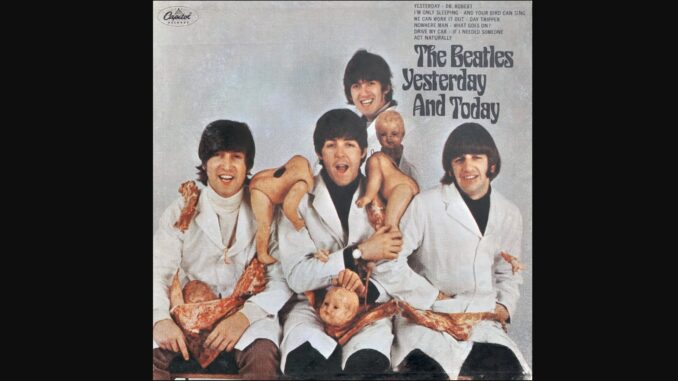
Yesterday And Today is the title of the ninth album by The Beatles released by Capitol Records in the United States and Canada in June 1966.
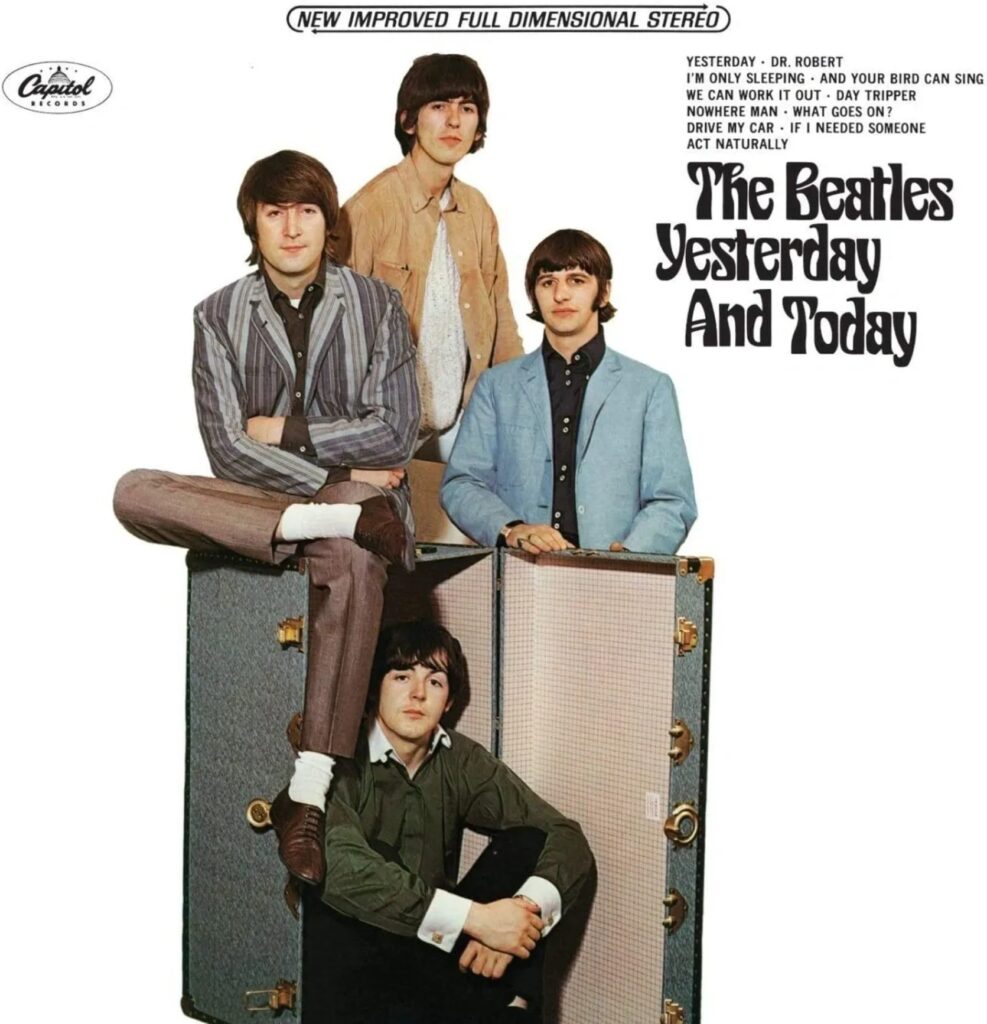
The album is remembered primarily for the controversy surrounding its original cover image. Nicknamed the “butcher cover,” it depicted the band in white butcher smocks and covered with decapitated baby dolls and pieces of raw meat. The album was withdrawn almost immediately in response to retailers’ concerns about the gory imagery. The cover image was replaced with a shot of the band gathered around a steamer trunk.
Most of the worldwide audiences will never have seen an album called Yesterday And Today, and certainly not the “butcher” variant. This was a release for the North American markets. Before 1967, all NA Beatles releases were different than in the UK and the rest of the world.
Why, I hear you ask?
A crucial part of the story is that EMI’s American subsidiary, Capitol Records, repeatedly rejected every Beatle release that EMI offered to them throughout 1962-63. They refused to release as much as a single, amazingly citing doubts about their commercial appeal even as the rest of the world were in the throes of Beatlemania.

The explanation is simple: the key decision-maker, Dave Dexter Jr., was a jazz enthusiast with a strong bias against rock and pop. He dismissed The Beatles as “just kids” and famously said of their first single Love Me Do: “When I heard (John) Lennon playing a harmonica on this record, I thought it was the worst thing I ever heard…. I didn’t want any part of the Beatles.” The harmonica on Please Please Me got a similar reaction. He never changed his stance on this.
This was clearly a major misjudgement, in many ways mirroring Dick Rowe’s (Decca’s head of A&R) rejection of the Beatles when they auditioned for his label in 1962. This blunder stuck with Rowe for the rest of his career as one of the most legendary misjudgements in music history, although he redeemed himself somewhat by signing The Rolling Stones some months later.
Dexter Jr.’s own misjudgement is easily on the same level, but his reputation was somewhat saved by others when he was forced to release Beatle records against his will. EMI UK and Beatle manager Brian Epstein had grown frustrated with Capitol’s repeated rejections, and in the end, Capitol was ordered to release the single I Want To Hold Your Hand in December 1963. The timing was excellent, as CBS had just aired a TV segment about Beatlemania. Interest surged, and for a while, 10,000 copies an hour were sold in New York City alone. This was the single that broke the band in America.
The point had now been proven. Capitol never looked back, starting to release Beatles records in NA from that point onward. The label had amassed a backlog of material which they decided to use tactically. Rather than simply retroactively releasing the singles and albums, they opted for repackaging and portioning it out. Songs were put together into new constellations to produce as many new albums as possible. They altered track listings, artwork, album titles, number of tracks per album (usually a few tracks less than the UK counterparts), and even set up their own release schedules to suit their own commercial norms.
The most unforgivable thing they did was to alter the music itself. They would add reverb, tweak EQ, alter mixes, and reshuffle stereo channels. Most of this was done under Dexter Jr.’s supervision, who felt American audiences preferred a more live/spacious sound and went to any lengths to tweak the tracks accordingly. Listen to the US version of She’s A Woman, which is drenched in reverb, and I Feel Fine, where the US version has a pronounced echo not present in the UK mix, just to name a few examples.
This frustrating meddling was done against band, producer George Martin, and manager Brian Epstein. The band carefully considered and planned every aspect of their releases: track listing, running order, inclusion of singles, album cover design, and the final sound mix of each track. This didn’t matter, as the contracts allowed Capitol to decide how the product was released to their market place. This resulted in several ‘unique’ North American albums, such as The Beatles’ Second Album, Something New, and Yesterday And Today. They were all composite collections with material pulled from various UK releases.
The Beatles finally got control of the situation in 1967 when they renegotiated their contract. This included final approval of all US releases, starting with Sgt. Pepper’s Lonely Hearts Club Band. There would be no changes or differences between territories from that point onward.
In the eyes of the rest of the world, the practice by the American label equalled butchering the albums, but there are generations of fans who primarily relate to the Beatles in terms of these versions of the albums. It’s understandable, as those were the albums they grew up with, but it can make for some schizophrenic listening. The Beatles had a rapid development technically, stylistically, and production-wise. With some of the composite albums spanning material recorded nearly a year apart, parts of an album could sound older/more basic than the rest – because it was!
This is the backdrop that existed when Capitol started putting together a new Beatles album for the NA region in 1966, which finally takes us back to Yesterday And Today.
Yesterday And Today would include songs from the EMI albums Help! and Rubber Soul, some unique single tracks, as well as three new 1966 recordings that would later appear on Revolver in countries outside North America. The result is an album with yet another long timespan in terms of when things were recorded. The oldest song included is Yesterday (and the album’s title is indeed a play on this popular song), recorded on 14 June 1965, while the newest track I’m Only Sleeping was recorded in the first week of May 1966. This is a timespan of nearly 11 months.
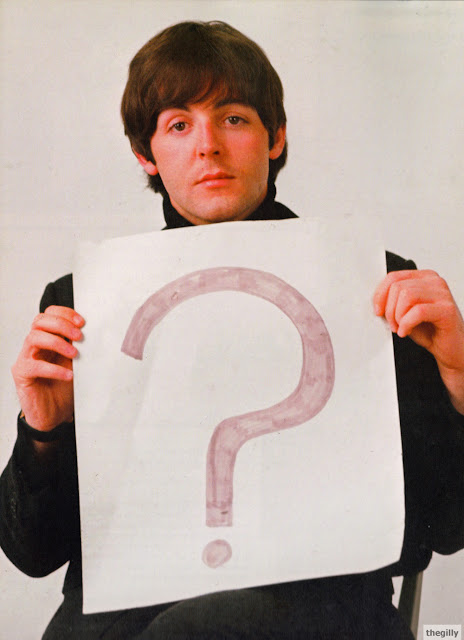
The “butcher” cover was never meant to be the cover image for this album. To understand what this photo is all about, let’s go back to the original photo session. It was held on 25 March 1966 at Vale Studios in Chelsea, London.
The photographer was Robert Whitaker, who had taken promotional and sleeve images of the band before. This was planned to be a different type of session, though. Having spent three months away from the public eye, the band members had expanded their interests and were eager to depart from the formula imposed on them as pop stars, both in their music and in their presentation. Whitaker similarly had ambitions that the photo session should break new ground.
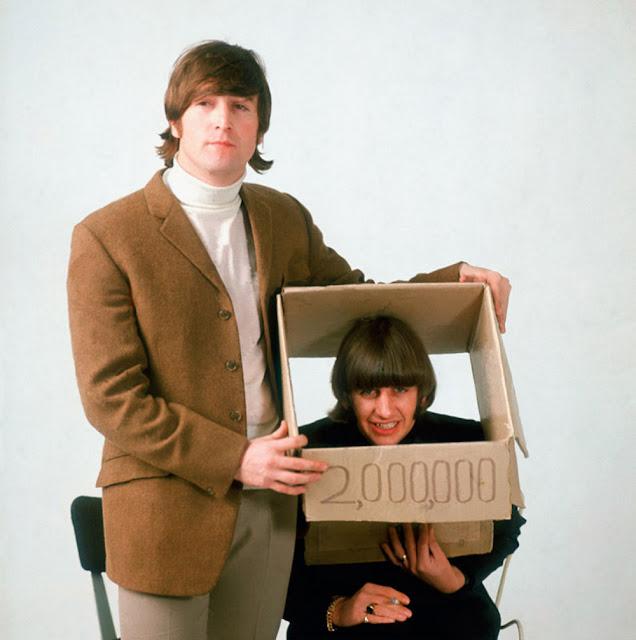
Whitaker had planned a conceptual art piece titled A Somnambulant Adventure, which he later described as “a considered disruption of the conventions surrounding orthodox pop star promotional photography.” He conceived the piece as a comment on the Beatles’ fame, having accompanied them on their August 1965 US tour and been alarmed at the scenes of Beatlemania he witnessed then.
The session began with conventional poses, including portraits with neutral expressions and simple attire. Whitaker then experimented with props like false teeth and eyes, hammer and nails, a birdcage, cardboard boxes, distorted lighting and symbolic arrangements. His aim was to challenge the sanitised image of the Beatles as pop icons.
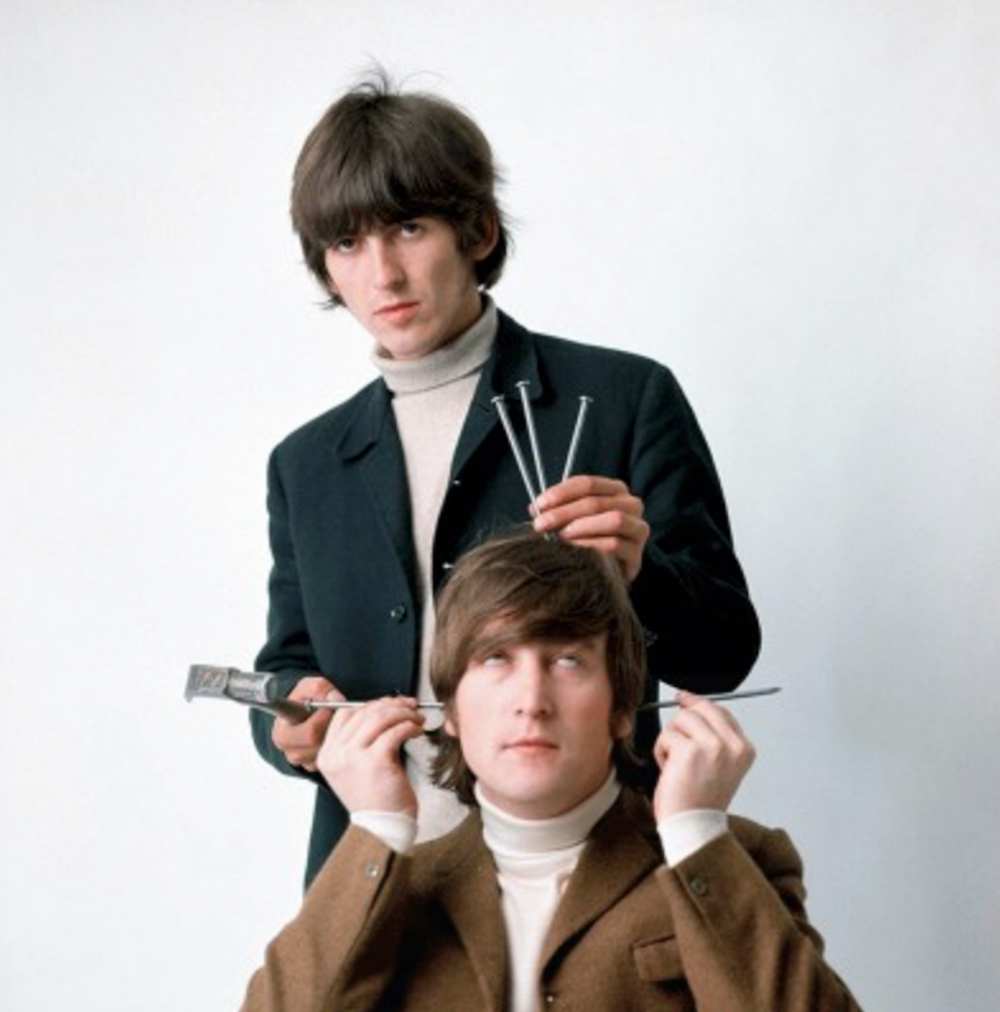
During the shoot, he took several reels of film of the band members interacting with the objects. On one image, Paul McCartney holds a question mark prop. Several of them had their heads inside the bird cages. On another, George Harrison pretends to hammer a nail into John’s head, seeking to prove that despite their idolised status, the Beatles were mere mortals of flesh and blood.
Midway through the session, Whitaker introduced white butcher smocks, which the Beatles wore with playful indifference. He then added raw meat, more false teeth, and eventually dismembered baby dolls, creating a grotesque tableau that blurred satire, surrealism, and protest.
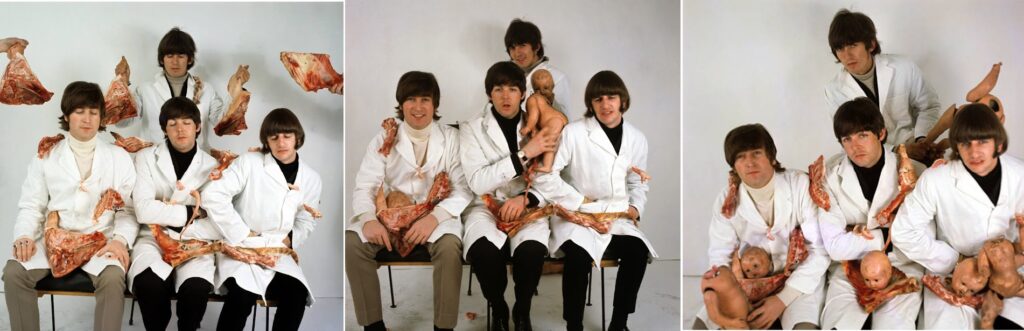
“The photographer was a bit of a surrealist and he brought along all these babies and pieces of meat and doctors’ coats, so we really got into it,” Lennon told Dennis Elsas on WNEW-FM on 28 Sep 1974. “And that’s how we felt – ‘Yeah!'”
The Beatles were happy enough to go along with the setup. They all had different perspectives on the session after the fact, which may in part come from how one of the “butcher”-images ended up being used. On that day, the images were very much part of a whole, meant to fit within the context of the session rather than standing on their own. The band were developing an appreciation for avant-garde art forms themselves, and would even end up experimenting with this on their later albums.
Related article: The Story Behind the Song «Revolution 9» by The Beatles
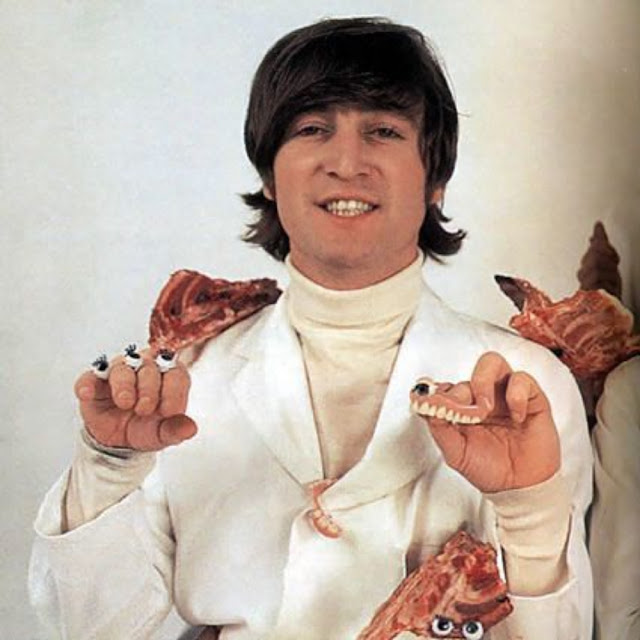
Again, Whitaker or the band never intended any of these photos as any kind of album cover. It was part of a larger artistic statement on fame and idol worship.
A few months later, Capitol Records have started assembling the Yesterday and Today album, which they plan to have ready for release in NA on 15 June 1966. As per usual procedure, they ask Brian Epstein for photos of the band to be used on the cover. This coincides with the band being in Epstein’s office on 29 April 1966 to do an interview with the German publication Bravo ahead of a tour in Germany. Robert Whitaker is also present, and ends up snapping pictures of the band posing around a steamer trunk which are developed and submitted to Capitol for consideration.
For that meeting, Whitaker had also brought along early black-and-white treatments of their March photo session. This occasion is when the band sees the images, including the “butcher” ones, for the first time. They love the images, and there are several photos from this day showing the band members gleefully looking at the unorthodox images of themselves.
A week or so later, Epstein receives Capitol’s suggestions for the album cover. He is not thrilled. The steamer trunk photo has been used, but the general layout is based it on the Yesterday single with a broad blue sidebar featuring the band logo in white and song titles in yellow. It might have been a nice throwback to the single, but did not work well as a full album format. Epstein asked them to come up with something else.
Fast forward a few more weeks to 19 May 1966. Epstein has just received several variation covers which all use the steamer trunk image in various forms. At this point, Epstein has realised that the steamer trunk image just isn’t very exciting for album cover use. On that same day, the Beatles are doing a video session for their new songs Paperback Writer and Rain at Abbey Road. On that day, they see the full colour prints of the March photo sessions for the first time, and are even more thrilled with these than the black-and-white ones.
The next day, the band have some follow-up video sessions taking place in Chiswick Gardens. At this point, Epstein is also present, and he has brought along the latest cover image mock-ups from Capitol. He wants the band’s input, and they agree that the cover is boring and unexciting. This is when John Lennon gets a bright idea.
The “butcher” images were very much on their mind, as they had just seen those images the day before and were still talking about them. This is when Lennon tells Epstein that he wants the “butcher” colour image to be the cover of the album. More than any other Beatle, Lennon in particular found those images refreshing and exciting. He felt trapped in the band’s clean-cut image and was keen to break it, as well as reflect the band’s awareness of darker realities. It resonated quite deeply with him at the time.
Epstein was horrified by the suggestion, but Lennon was insistent. When Paul McCartney heard the discussion happening he also immediately found the idea of using that image a fun one, chiming in with an “Oh yeah, that’s cool!” John and Paul ended up becoming unified in their wish to use that image as the album cover. The others offered no protests.
Epstein ended up having to go along with this suggestion. By 1966, he was no longer the one making the decisions. The dynamics between the manager and the band had changed. They may still have listened to Epstein, but ultimately it was now the Beatles – usually meaning John and Paul – who made these types of decisions. Brian’s marching orders, to his horror, was to present the “butcher” cover to Capitol as the new cover image, which he very reluctantly did.
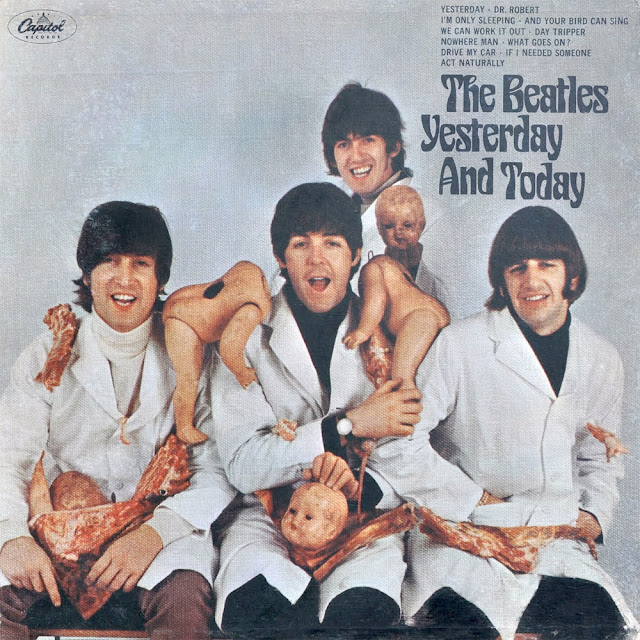
The photo was received by Capitol’s art director George Osaki a few days later. He immediately got very excited. As an art person, he loved the image and everything it represented. There was no question in his mind that this was infinitely more interesting as a cover design than the steamer trunk photo. He threw himself into designing the cover around it.
That view would not be widely shared within Capital. Alarm bells started to chime as soon as the sales force saw the results. Let’s not put too fine a word on it: they panicked. A mock-up of the cover promptly ended up on the desk of Capitol president Alan Livingston, who was so alarmed by the image that he called Epstein directly to request a change.
Livingston did his best to insist to Epstein that there was no way they could put out this cover in America. This was met with a blank refusal to change anything from Epstein. The interesting thing was that personally, Epstein fully agreed with Livingston – but he would not say that. As always, he stood faithfully by his band, repeating that this cover was important to them. Eventually, Livingstone becomes curious about the reasons this cover is so important and starts asking about its meaning.
In a previous discussion about this, Lennon had said something to the effect of “If Americans can accept the war in Vietnam, they can accept this cover.” The comment was mostly pointing out what he felt was a double standard, but this might have opened the door to coming up with a rationale related to the war.
Paul McCartney was at hand when Livingston called, and ended up talking with the Capitol president. And he went with that narrative, telling Livingston that the photo was the band’s commentary on the Vietnam War.
Let’s keep in mind, once again, that when Robert Whittaker shot this image of the band two and a half month earlier, war or other societal issues has no part in inspiring the session. The band could obviously have applied that meaning to the photo since then, but it also feels like a post-hoc justification – maybe even a white lie, if you will – to get Capitol to stop their protests and just make them go along with using the photo.
Amazingly, it worked – sort of. After having heard McCartney’s reasons, Livingstone decided to give that version of the cover a small test run. He called the production people and told them to do a small production number (a couple of hundred or so) to show around and get some opinions – i.e. to do some basic market research. He wanted to respect the artistic intent of The Beatles – maybe not at every cost, but he was at the very least willing to see if there was a way that they could make it work. It was a generous and very untypical decision to try to do right by the band. It was too much, too late, and definitely at the wrong time.
This is where things went wrong. It is now late May 1966. The production department were on full alert to start printing the next Beatles album at maximum speed the moment it was greenlit. They had a huge amount of work ahead of them, and the goal was still to have the record in every shop by the planned release date of 15 June. They desperately needed the covers made, and had less than two weeks to get them ready.
In this climate of nervous urgency, Livingston’s message to proceed with a test pressing was somehow interpreted as a go-ahed for a full production run. Just like that, Capitol were in full, turbo-charged production mode. Yesterday And Today was being manufactured – with the “butcher” image on the cover!
To make matters worse, there was a new directive in place at Capital to improve the initial availability of new Beatles releases. They had never managed to have new Beatles records in all shops and/or in satisfactory quantities on release day, which meant that hundreds of thousands of fans were always disappointed. This time, Capitol has taken steps to make sure this would be the first record to be fully available everywhere on release day. They were going hammer and tongs to print up as many copies as needed and ship them nationwide in time for release day.
The first ones to receive copies were the hundreds of radio station reviewers, who received theirs a week or so before the release date. The majority reacted poorly, telling Capitol in no uncertain terms that the cover was in extremely bad taste. Shortly after, it reached retailers, most of which had planned to make the album a featured part of their store promotion. Just about all of them quickly reconsidered, many going as far as refusing to display it.
Capitol did not need more feedback to reconsider. The “butcher cover” version of Yesterday And Today had not even been in the shops for a single full day when the so-called Operation Recall was put into effect.
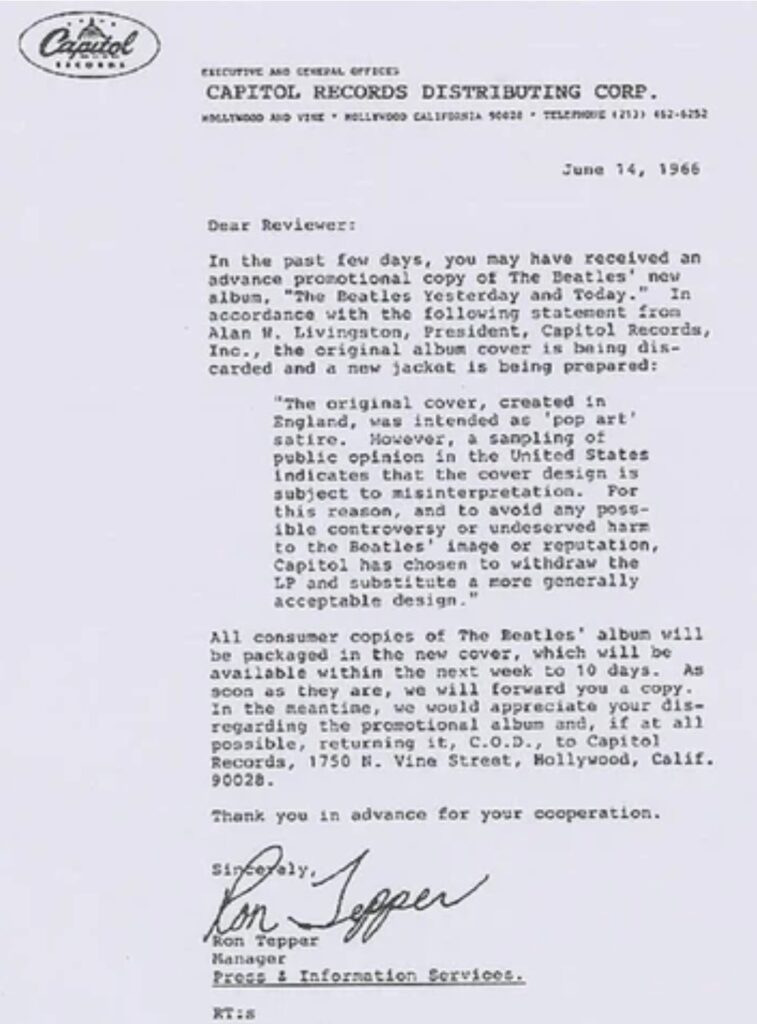
In short: all commercial copies were recalled by Capitol. Letters were also sent to reviewers and radio stations who had received preview copies, telling them it was a mistake, it was a cover that might have worked in the UK but never should have been released in America, and asking them all to return the copies. In spite of the number of complaints fro said radio stations and reviewers, Livingston later claimed in an interview that nobody ever returned their copies.
In a contemporary article in Billboard Magazine, Capitol stated that no copies had been sold to the public. This is demonstratively untrue, as a number of the albums made it onto retailers record shelves for a few hours, especially in the wider Los Angeles area. A few large chain stores like Korvettes and Sears also placed the “butcher” album out for sale a day or two before the official on sale date and consequent recall. The window to obtain the album was relatively short, though, and it is estimated that only a few thousand copies of the Butcher cover survived the recall, making it a rare find.
The recalled albums were going to be reissued in a new cover, and tens of thousands of already-printed colour covers were sent to a landfill – at least 50,000 of them ended up in a deep watery pit that was then filled with earth over one weekend at the end of June 1966. A gift to future archaeologists, possibly?
A new cover was now desperately needed, and at breakneck speed Capitol brought back out – yes, you’ve got it! – the previously discarded steamer trunk photo! This time they bulldozed ahead and just printed it as quickly as possible without asking anyone in the Beatles organisation, placing the vinyl from the previous run inside the freshly made covers.
And just like that, the “butcher” cover was history. Or… was it?
Capitol had lost a lot of money over the whole “butcher” debacle, so they were keen to save money where they could. One bright idea was to produce a new front image that could be pasted over the original “butcher” image, and they proceeded with this idea. This allowed them to have more replacement copies in the stores quicker, and by 20 June, the newly printed album covers were put on sale.
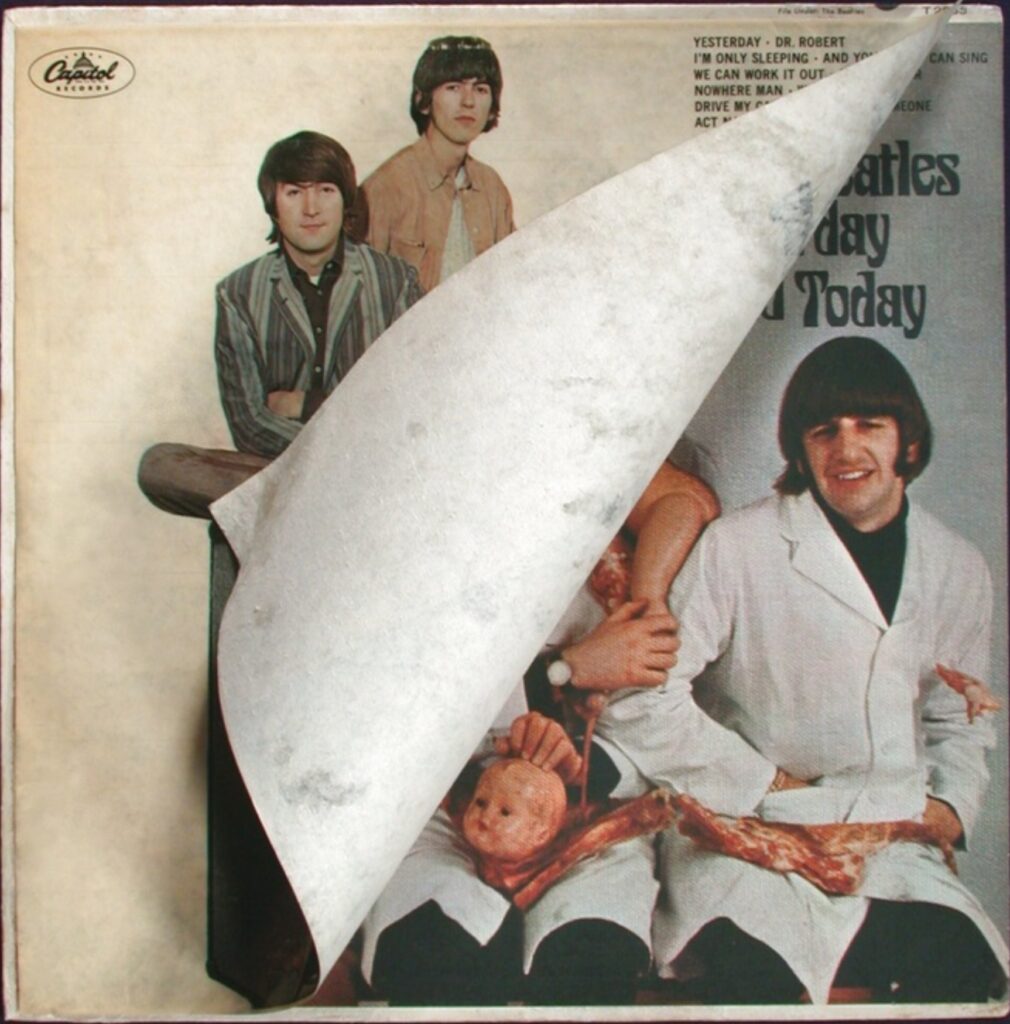
Beatles fans quickly discovered that Capitol had applied a peel-over on several of the copies, and began peeling the pasted cover off to reveal the “butcher” cover – some with more success than others, it has to be said. It became an art itself to remove the steamer cover without damaging the butcher cover.
There are three versions, or so-called “states”, of the cover today. An original, untainted cover from the original run is known as “first state”. Pristine copies of this version will fetch astronomical prices at auctions. In 2016, Heritage Auctions set a world record when it sold a sealed original copy of the butcher cover for $125,000, whereas elsewhere, excellent condition “first state” copies are known to sell for upward of $70,000. The price will ultimately depend on many factors including condition, whether the LP is stereo or mono, and if it is open or still sealed.
The best quality “first state” copies comes directly from Alan Livingston. When the original cover was scrapped in June 1966, Livingston took a case of already-sealed “butcher cover” albums from the warehouse before they were to be pasted over with the new covers, and kept them in a closet at his home.
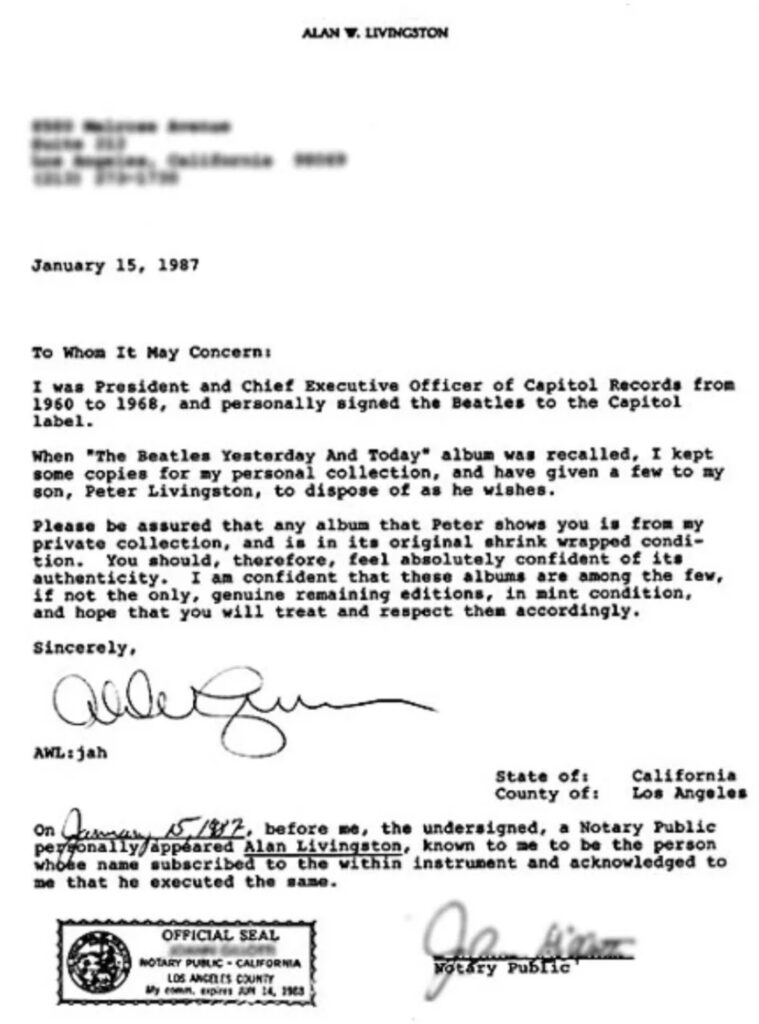
In 1987, his son came across them and wondered if he could bring along some to sell at a Beatlefest convention at the Marriott Hotel near Los Angeles International Airport during the Thanksgiving weekend. Alan simply told his son that he could do what he wanted with them; they were his. He sold a few for $2000 each, but paused the sales when he realised how happy people were to obtain these treasures for the sum asked. The rest has largely gone out through auction houses over time.
These still-sealed pristine items, which included nineteen mono and five stereo versions, are the very rarest and most valuable ‘butcher covers’ in existence. These so-called “Livingston Butchers” today command premium prices among collectors, the five stereo versions being the most rare and valuable of these. The son made his father write up a letter of authentication, which follow these copies.
More common is the “second state” variety, which is an unpeeled cover that has the “butcher” artwork underneath. These are easiest detected by a keen eye spotting Ringo’s black v-neck shirt on the right side, showing through a white area on the steaming trunk cover. A “third state” is a peeled cover, most of which have given a very poor result with tears and stain marks, although some very skilled “peelers” created some very good collectibles. None will still ever look as good as a first state that never had glue attached to it.
Experts warn, if you find an old copy of Yesterday And Today that has the original butcher cover underneath the pasted new cover – do not try and peel it yourself. If you decide you want to have a butcher cover there are professionals who can peel the trunk cover without ruining the image underneath.
The final word should go to the four members of the band. How did they feel about the infamous cover once the dust had settled?
John Lennon had been the driving force behind using the “butcher” photo as the album cover, and he always stood by it. In a 1980 interview with David Sheff, Lennon said: “It was inspired by our boredom and resentment at having to do another photo session and another Beatles thing. We were sick to death of it. Also, the photographer was into Dalí and making surreal pictures. That combination produced that cover.” In a 1974 radio interview with WNEW-FM in New York, he also described the original sleeve as “obscene and repulsive to the public, but a bloody chuckle to me now.”
Paul McCartney has also revealed a soft spot for that photo session. In the 1995 Anthology book, he said, “We’d done a few sessions with Bob before this, and he knew our personalities: he knew we liked black humor and sick jokes. And he said, ‘I’ve had an idea – stick these white lab coats on.’ It didn’t seem too offensive to us. It was just dolls and a lot of meat.” Macca sees it in context of the band’s experiments with avant-garde art and surrealism, which admittedly did not sit comfortably alongside the image the band had at the time.
George Harrison was the most critical of the “butcher” cover in retrospect. In the 1995 Anthology book, he admitted, “I thought it was gross, and I also thought it was stupid.” He also commented on his expression in the photo: “So we put on those butchers’ uniforms for that picture. In the photograph we’re going, ‘Ugh!’ That’s what I’m doing, isn’t it? I’m disgusted, and especially so by the baby dolls with their heads off. What the bloody hell is that all about?” He said that sometimes the band did things thinking they were cool or hip, but in hindsight, they were just mistakes. Harrison believed the record company was right to replace the butcher photo with a different image.
Ringo Starr has also indicated a dislike for the cover. In a 2018 interview with Dan Rather on ACS TV, he laughed about it before calling it “the worst thing we ever did.” He said it was tasteless and regretted being associated with it, although he has been happy to sign copies for collectors, being at peace with its part in Beatle history.
Facebook Comments