
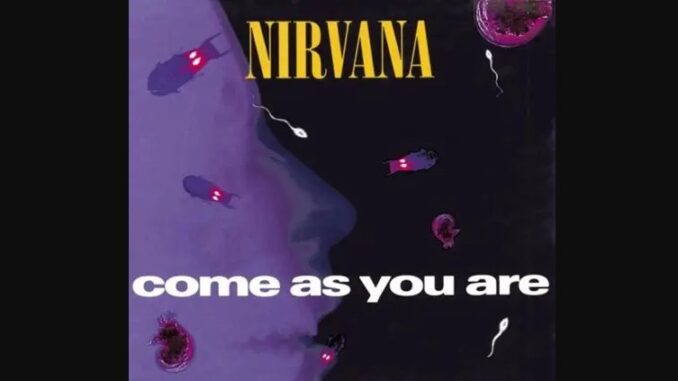
Can anything be said about Nirvana and their Nevermind album that hasn’t been said before? The album came out of nowhere in 1991, and its popularity kept growing until it replaced Michael Jackson’s Dangerous at the top of the US Billboard chart in January 1992.
That moment signalled a significant cultural shift, spearheaded by the single Smells Like Teen Spirit which reached the Top 10 of most singles charts around the world. The song would later be inducted into the Grammy Hall of Fame.
The album and song brought Nirvana worldwide fame. Their importance cannot be overstated. Kurt Cobain became the voice of a generation. The band brought grunge and alternative rock to a mainstream audience, signalling that the happy, colourful 1980s were well and truly behind us. Nirvana helped initiate a resurgence of interest in the punk DIY culture among teenagers and young adults.
At this point, the album has sold more than 30 million copies worldwide, making it one of the best-selling albums ever. In 2025, it was certified 13 times platinum by the Recording Industry Association of America. Modern ranking services that combine physical sales, downloads, and streaming equivalents estimate “equivalent album sales” totals of over 60 million. Nevermind was added by the Library of Congress to the National Recording Registry as “culturally, historically, or aesthetically significant,” and frequently appears on lists of the greatest and most important albums of all time.
The fact that Nevermind became so successful, making Nirvana an overnight sensation, actually ruined my own chance to see the band. They were scheduled to play in Hulen in Bergen in 1992, but that whole European club tour was cancelled for significantly more grandiose plans when the band took off in a way nobody had foreseen.
Smells Like Teen Spirit might have been the spearhead, but the other singles Come As You Are, Lithium, and In Bloom were also very successful.
Come As You Are was the second single from the album, and the song that was given the thankless task of having to follow Teen Spirit. The first single had immediately become iconic in a way that you simply couldn’t expect a follow-up to be, but Come As You Are did quite okay. It is a stellar song in its own right, but also a different kind of song than the previous single, showing that Nirvana were far from one-trick ponies.
Kurt Cobain had written the song in early 1991. He was listening to a lot of British punk at the time and was fooling around with a guitar riff inspired by the Killing Joke song Eighties. He played it much slower and placed the riff within a different vibe. In Cobain’s hands, the riff was transformed into something that sounded relaxed, hypnotic, and accessible, while also keeping that ominous element creeping in the song’s shadows.
Everything begins with the iconic opening guitar riff, played with a chorus effect. Cobain ended up using an Electro-Harmonix Small Clone guitar chorus pedal to give his instrument a somewhat watery, or echoey, tone during the verses and pre-choruses. As a result, the pedal and that specific sound has been associated with the song ever since.
The riff is built around E minor, which goes a long way in contributing the song’s darker, more introspective mood. A lot of the song’s hypnotic effect comes from the way it moves around in a slow, circular pattern rather than driving forward aggressively. It functions almost like a mantra: a few notes repeated with slight movement, creating a relaxed yet uneasy atmosphere. The song seems deceptively simple, but the build is very well constructed and there is a lot going on.
When the band comes in, they are notably restrained compared to many other Nirvana songs, particularly Dave Grohl’s drumming, which quickly establish a steady pulse to support the hypnotic character of the guitar riff. Krist Novoselic’s bass lines avoid competing with the guitar, instead reinforcing the groove and thickening the low end, helping create the song’s slow, rolling momentum.
Before we get ahead of ourselves, let us backtrack nearly a year to spring 1990, and the start of the story of Nevermind. This was well before tracks like Smells Like Teen Spirit and Come As You Are had been written.
Nirvana had seen modest success with their first album Bleach, released two years earlier. Reviews had been good, and people like Sonic Youth’s Thurston Moore had spoken highly of it, but it wasn’t reflected in the sales. Before Nevermind was released, Bleach had sold at most 40,000 copies in North America.
The band selected Butch Vig as a producer for their second album. As soon as he was on board, the band travelled to his Smart Studios in Wisconsin to record basic versions of all the songs Cobain had written. They did that is just four days, from 2 to 6 April 1990. Most of the basic arrangements were complete but Cobain was still working on lyrics, and the band was unsure which songs would make it.
Two significant things happened over the next months. First, their original drummer Chad Channing left, putting additional recording on hold. Cobain and bassist Krist Novoselic found his replacement, a young upstart called Dave Grohl, when they say him perform with a hardcore punk band called Scream. A connection was made, and when Scream fell apart, they got in touch. Novoselic said in retrospect that with Grohl, everything “fell into place.”
Also, later that year, Nirvana’s record label Sub Pop found themselves in financial difficulties. With rumours that they would become a subsidiary of a major record label, Nirvana decided to cut out the middleman and look for a major record label with which they could sign directly.
Within a few months, the recent recordings were circulating as a demo tape among major labels. Some of these labels ended up courting them before Nirvana decided to sign with the Geffen Records imprint DGC Records. The deciding factor might have been a recommendation from Kim Gordon of Sonic Youth and their management company.
After Nirvana signed to DGC, a number of producers were suggested, including Scott Litt, David Briggs, Don Dixon, and Bob Mould. Novoselic said the band had been nervous about recording under a major label, and the producers suggested bu DGC wanted percentage points. The band went with their gut feeling and held out for Butch Vig, with whom they had become very comfortable collaborating.
With a budget of $65,000, Nirvana could finally record Nevermind at Sound City Studios in Van Nuys, California, in May and June 1991. They were not financially stable, to say the least, and had to play a show at Seattle’s OK Hotel on 17 April to earn gas money for the drive to Los Angeles. This show is now significant as the first ever public performance of Smells Like Teen Spirit.
The band had sent Butch Vig rehearsal tapes prior to the sessions that featured newer versions of the songs recorded previously at Smart Studios, plus newly written songs including Teen Spirit and Come As You Are.
Whatever reservations there might have been about similarities between Come As You Are and the Killing Joke song had at this point been pushed aside. Butch Vig loved it, saw it as one of the key songs from the session, and was determined to capture it. The band loved it, too.
Cobain is joined by the rest of the band for the first verse, which is moody and subdued. This predictably changes once the band reaches the chorus, as the song has the classic Nirvana trait of soft verses and louder choruses.
The lyrics and music works together in setting up the comforting-contradicting elements. “As a friend, as an old enemy,” “Take your time, hurry up,” with opposing ideas mirrored by the music. The tempo is steady, but the harmony feels unsettled. The chorus effect creates warmth, but also distance. The riff is repetitive and familiar, yet slightly ominous.
This contributed elements to the song that allowed it to remain accessible to mainstream audiences while preserving Nirvana’s underlying tension and melancholy.
Come as you are, as you were
As I want you to be
As a friend, as a friend
As an old enemy
Take your time, hurry up
Choice is yours, don’t be late
Take a rest as a friend
As an old memoria
Memoria
Memoria
Memoria
Many have speculated that the song is about heroin, which Cobain was struggling with at the time of writing and recording. The lyrics “Come doused in mud, soaked in bleach” speak directly to a Seattle-area HIV prevention campaign from the time which encouraged addicts to sterilize their needles with bleach before using them with the tagline “If doused in mud, soak in bleach.” The lyrics “As a friend, as a trend, as a known enemy,” for some, were a further allegory for addiction to the drug.
This was not a topic during the recording of the song, which was done smoothly enough. Or, as smoothly as can be expected when your frontman is hooked on heroin. Novoselic and Grohl finished their tracks in days, while Cobain worked longer on guitar overdubs, vocals, and lyrics. He was known for finishing lyrics just minutes before recording.
Come doused in mud, soaked in bleach
As I want you to be
As a trend, as a friend
As an old memoria
Memoria
Memoria
Memoria
And I swear that I don’t have a gun
No, I don’t have a gun
No, I don’t have a gun
During the song’s harmony overdub session, Cobain accidentally sang the phrase “No, I don’t have a gun,” appearing the fourth time he sings the word “memoria” after the guitar solo. When this mistake was discovered, Cobain decided to keep it in the final recording. Vig sampled Cobain singing “memoria” from the middle of the song and placed it in the background of the song near the end twice.
Cobain recorded his guitar solo in two takes, as well as three takes of vocals of which the first was used. Vig then asked Cobain to double track his vocals throughout the entire song. Cobain refused, wanting the take to be raw and real. Vig kept trying to persuade him, finally succeeding when he when he told him that John Lennon used to do it.
The song features one of Cobain’s longest guitar solos. “Kurt really did not play a lot of solos,” Vig told biographers Berkenstadt & Cross in 1998. “This one is more of a melodic part based on the vocal melody. It’s not trying to show off pyrotechnics. It complements the melody of the song.”
Though the sessions generally went well, Vig also said that Cobain would become difficult at times: “He’d be great for an hour, and then he’d sit in a corner and say nothing for an hour.” Considering his drug struggles during the recording of the album, this honestly sounds par for the course, but also very sad.
With the album finished, DGC were gearing up to release it, which they did on 24 September 1991.
It didn’t feel like the momentous occasion of a historic release. The label’s initial expectations were modest. They crossed their fingers and hoped for a slight increase on the sales of the first album, reportedly shipping about 46,000 copies in the United States as Nirvana headed out on tour.
We can laugh about that number today. Demand outran expectations very quickly, as Smells Like Teen Spirit started making waves through alternative radio and MTV. By November 1991, Nevermind had gone gold in America.
The defining chart moment came on 11 January 1992, when Nevermind reached #1 on the Billboard 200. By then, the band’s sudden rise had become one of the biggest music stories in the world.
The band’s success shifted the eyes of the world towards the Pacific Northwest’s underground rock scene, exposing bands like Pearl Jam, Soundgarden, and Alice In Chains to an enormous mainstream audience. They all achieved major commercial success during the same period, while record labels began searching aggressively for alternative bands that might capture some of the same audience.
Come As You Are become the second single for Nevermind, so a music video was commissioned. Filming took place a week after the album reached #1, on 16-20 January 1992. They shot outdoor footage in Wattles Park in Hollywood hills a few days prior to the main video shoot, which took place in an Air National Guard hangar at Van Nuys Airport. Kevin Kerslake who directed it would project this footage in the background of any shots in the main part of the video.
The video features the band in a dark room, where the appearance of falling water in front of the band distorts and blurs the band members’ forms (an idea suggested by Cobain). Clips of cells multiplying and orgaisms are also shown throughout the video, which also features Cobain swinging violently on a chandelier as water starts flowing into the room they are in.
Come As You Are was also performed acoustically during their MTV Unplugged performance on 18 November 1993, also appearing on the live album of the performance, released about a year later in November 1994 after Cobain’s death. Needless to say, the song fit the restrained atmosphere perfectly.
So, what happened with Killing Joke and the discussion about song similarities?
Before we get into that, it is important to keep in mind that when the band started planning their second album, they were still not really that well known. Who knows if this made Cobain less concerned about where he picked up inspiration from. It wasn’t uncommon for musicians to use something they’d heard elsewhere as a starting point. After playing around with the original idea, they’d usually end up with something different. The big question becomes, when does it become different enough to be considered a different song, and how much of the original inspiration is it OK to keep? Come As You Are and Eighties are clearly two different songs, as much as they also share some of the same guitar build.
When the time came to pick the second single, Nirvana was a huge band. Not just in the US, but around the world. The record company was firmly behind Come As You Are, but Cobain had gotten more concerned over the song’s similarity with Eighties.
Danny Goldberg, head of Nirvana’s management Gold Mountain, later revealed that “we couldn’t decide between Come As You Are and In Bloom. Kurt was nervous about Come As You Are because it was too similar to a Killing Joke song but we all thought it was still the better song to go with. And, he was right, Killing Joke later did complain about it.”
Commercial considerations won the day over likeness concerns. Nirvana biographer Everett True writes that the song was eventually chosen because “Goldberg favoured the more obviously commercial song.”
Today, the narrative that is going around is that whilst the members of Killing Joke complained that the Nirvana riff plagiarised elements of Eighties, they did not file a copyright infringement lawsuit. According to a 2003 article in Rolling Stone, the reason was attributed to “personal and financial reasons.”
However, there are conflicting reports. Several reports state that a lawsuit was filed, but either thrown out of court or dropped. Kerrang claims that there was a lawsuit that failed, but other outlets mention that the lawsuit was withdrawn after the suicide of Cobain in April 1994, out of concern for a young girl who lost her dad, as well as for Dave Grohl and Krist Novoselic who lost a friend and ended their band.
Songfacts asked Killing Joke frontman Jaz Coleman about their decision not to sue, and he said “It’s a short fucking life, mate. We could be going fishing or something sensible.”
Perhaps it’s just as well that Killing Joke let sleeping dogs lie. Things could have gotten a bit embarrassing, as it turns out that the very same guitar riff shows up in the song Life Goes On by The Damned! The track is found on their Strawberries album released in 1982, meaning it predates the Killing Joke song by three years. Should The Damned have sued Killing Joke? Or perhaps they should even have taken on Nirvana?
Years after the whole Nirvana debacle, Killing Joke vocalist Jaz Coleman claimed no knowledge of Life Goes On. He said “I’ve never heard that song! Well, how come they didn’t sue us, then? [both laughing] No, I didn’t know that! I’ll point that out to the boys in The Damned! Same song? Really? [interviewer hums riff] Woah! Ah, what the hell! Regardless, I’m glad we called our song Eighties so that we don’t have to play it again!”
Not filing a lawsuit would work out just fine for Killing Joke. Dave Grohl would later go out of his way to thank them for not potentially sabotaging Nirvana’s career when they easily could have. Grohl would also later play the drums on the entirety of Killing Joke’s self-titled eleventh album in 2003. The veteran British band were more than happy to have the former Nirvana man on the record, showing that the whole Come As You Are saga was firmly behind them all at that point.
Facebook Comments