
The beginning of this story takes us back to 4 October 1986. CBS news anchor Dan Rather was walking along Park Avenue in New York one evening, on his way back to his apartment, when he was confronted by two well-dressed men.
One of them asked him “Kenneth, what is the frequency?” When Rather replied that they seemingly had the wrong person he was attacked and punched from behind. The men chased Rather and knocked him to the ground, kept kicking him, and repeated that same question again and again. “Kenneth, what is the frequency?”
In describing the incident shortly after it happened, Rather said “I got mugged. Who understands these things? I didn’t [then] and I don’t now. I didn’t make a lot of it at the time and I don’t now. I wish I knew who did it and why, but I have no idea”.
The crime was solved in 1997, with the assailants identified and jailed. Until that happened, Rather’s description of the events sounded so bizarre that a lot of people doubted the veracity of his account. However, a doorman and building superintendent who came to his aid and helped stop the attack fully confirmed his version of events.
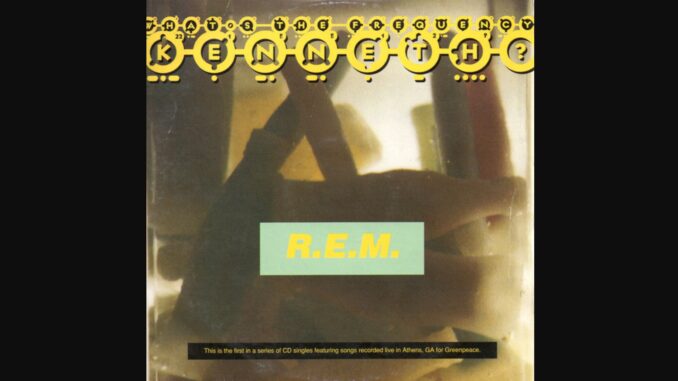
The assault got a lot of attention. The phrase “What’s the frequency, Kenneth?” even became a popular cultural reference over the years. It was used in graphic novels, TV shows, and music. In 1994, the phrase’s fame skyrocketed when a certain band from Athens, Georgia released a track with that phrase as its title. It was the lead single and opening frack of R.E.M.’s ninth studio album Monster.
R.E.M. had some wildly successful years behind them at the time. The band hadn’t been sure what to do next when they met for a week in Acapulco early in 1993 to plan their next two years.
Everything had gone well for them for quite a while. They started out as indie darlings in the early 1980s. Their shift from an underground college-radio-band to mainstream success was gradual, deliberate, and deeply shaped by their insistence on artistic autonomy. They moved from a fiercely independent, defiantly anti-commercial ethos to becoming one of the decade’s most influential alternative rock acts, all while preserving the core elements of their sound.
After years of releasing critically acclaimed albums on independent labels, they finally signed a major-label deal with Warner Bros in 1988 and released their sixth album Green. This was a very natural step for them to take, and they likely needed that growth to avoid getting stuck and risking stagnation.
As they moved into the 1990s, it became increasingly difficult for R.E.M. to maintain the aesthetic and principles that had defined their 1980s identity. Their seventh album Out of Time (1991), and especially tracks like Shiny Happy People, became a symbol of R.E.M.’s uneasy relationship with mainstream pop. They knew what they were doing, though. Tapes from album rehearsals has revealed a band that openly laughed about how unlike themselves that track sounded. It does, but it would be silly of them to avoid it for that reason alone. The band did the best they could to navigate major-label expectations, the pressures of global fame, and those ever-changing musical landscapes, even if this occasionally pushed them into uneasy territory.
One of their key decisions from that time was to not tour in support of the Out of Time album. In fact, they did not tour at all between 1989 and 1994. They were primarily burned out from a decade of relentless road work, but there was also discomfort with their sudden stadium-level status. Not feeling sure what that meant to them, they felt the need to protect their creative integrity and find a more natural way forward. After doing the required promotional activities, they simply took a break before getting back to start working on their next album.
What followed is one of the most fascinating artistic pivots in modern rock. It feels like the band spent the next few albums actively renegotiating their identity, as if they were correcting the course of their own narrative. That process began with 1992’s Automatic For the People. This album largely had an acoustic expression, as well as embracing orchestration and restraint. Thematically they were leaning into melancholy, with themes of aging, loss, and memory dominating the album. This was a deliberate counterweight to the image that had been projected onto them with the previous album.
This bleaker outlook happened to fit the overall music scene at the time, with grunge bands embracing similar themes with great aplomb. This meant that R.E.M. continued to be hip, and the melancholic ballad Everybody Hurts became another gigantic hit for the band.
They still did not tour, though. They once again produced music videos, did promotional activities, and took a short break. This takes us back to the band meeting in Acapulco in early 1993, where the band met to plan out their next two years.
The band had no idea what to do next. The lack of touring since 1989 was now becoming a significant point for then, as well as the last few albums being a bit different for them.
Some of the band members, particularly drummer Bill Berry, was adamant that the band needed to start touring again, and also that the next album needed to rock. “If we did another record like Out of Time or Automatic For the People, we’d be sitting on stools all night and swapping acoustic instruments, and that would be kind of boring,” he said in a New Zealand TV interview in October 1994.
The band agreed that after their previous two albums, they didn’t want to record another slow-paced album. They started putting together ideas with that in mind, and in August 1993 they got together for pre-production of their ninth album. This took place at Kingsway Studio in New Orleans under the supervision of Mark Howard, who had worked on Automatic For the People.
They were keen to give themselves a lot of options. Guitarist Peter Buck has said that the band brought in 45 songs, including “a whole album’s worth of acoustic stuff” which they demoed and put to the side.
The band never quite knew what type of album they were making until they started working on it. According to Mark Howard, these sessions turned out to be experimental, with the band experimenting with effects on their instruments and voices. Howard said, “The bass had a tremolo sound on it. It was a more inventive session for them.”
It took a couple of months before the song What’s the Frequency, Kenneth? showed up in October 1993. This song was both written and recorded at Kingsway Studio.
The attack on Dan Rather was no doubt what led Michael Stipe to that phrase. At the time, Rather’s assailant had not yet been identified, and media’s reaction to the case was to call it “The premier unsolved American surrealist act of the 20th century.” This fascinated Stipe more than the attack itself and is what the song really is about. He would often talk about how the song mostly is an attack on media and about how they often overanalyse things they don’t understand.
“What’s the frequency, Kenneth?” is your Benzedrine, uh-huh
I was brain-dead, locked out, numb, not up to speed
I thought I’d pegged you an idiot’s dream
Tunnel vision from the outsider’s screen
I never understood the frequency, uh-huh
You wore our expectations like an armoured suit, uh-huh
In talking to Mental Floss about the song in 2021, Stipe went on to say that the lyrics are about the fad of commentaries about Generation X, from the point of view of one such commentator. He said, “I wrote that protagonist as a guy who’s desperately trying to understand what motivates the younger generation, who has gone to great lengths to try and figure them out, and at the end of the song it’s completely fucking bogus. He got nowhere.“
Writing the lyric in character is an interesting move. Given that the album ended up dealing with the nature of celebrity and “the creepiness of fandom as pathology,” biographer Dan Buckley felt this “set the real Stipe at a distance from the mask adopted for each song.”
Peter Buck has also called the album a reaction to the band’s popularity: “When I read the lyrics I thought, all these guys are totally fucked up. I don’t know who they are, because they’re not Michael. I would say that this was the only time where he’s done characters that are creepy, and I don’t know if anyone got that. He was getting out his things by acting out these parts that are not him.”
It was perhaps inevitable that Dan Rather would interview R.E.M. about it all. When he finally sat down with Michael Stipe and Mike Mills in 2023, he asked them why they chose to write a song using a quote from the incident. Stipe explained that the question, and the song itself, represented “inscrutability.” Stipe described What’s the Frequency, Kenneth? as a song about “a character who’s desperately trying to understand a younger generation’s perspective and failing miserably at it. In the early 90s…there was a world-weary, kind of f***-it-all feeling coming out of grunge and that generation. This song was about someone who was really trying to tap into that.”
Stype built most of the lyrics to the songs on the album organically. The studio did not have a control room, so Mark Howard would record Michael Stipe singing lyrical ideas while lying on a couch. Howard commented, “Being able to put those vocals down helped him write the lyrics to a lot of songs on Monster.”
A line in the second verse goes “Richard said, ‘Withdrawal in disgust is not the same as apathy.'” This refers to Richard Linklater, who at the time had directed the films Slacker (1991) and Dazed and Confused (1993). In the years since, he also directed Waking Life (2001) and the acclaimed “Before” trilogy: Before Sunrise (1995), Before Sunset (2004) and Before Midnight (2013).
In the liner notes for the compilation album Part Lies, Part Heart, Part Truth, Part Garbage 1982–2011, Stipe says he quoted the director “to aid in a fictional narrative that details a generational belly flop the size of Lake Michigan.”
I’d studied your cartoons, radio, music, TV, movies, magazines
Richard said, “Withdrawal in disgust is not the same as apathy”
You smile like the cartoon, tooth for a tooth
You said that irony was the shackles of youth
This song is very much R.E.M.’s back-to-basics record. On the surface it can be seen as a return to their early days and the grimy, garage-band guitar sound and half-buried vocals. It’s still not quite the jangly folk-rock sound that defined much of their 1980s work. The song is built around Peter Buck’s thick, distorted riff, layered with fuzzy, overdriven power chords. Rather than his trademark chiming Rickenbacker arpeggios, Buck layers fuzzy, overdriven power chords. The guitars are heavily compressed and saturated, giving the track its dense texture.
Mike Mills’ bass adds to this, as they often double the guitar figure. It adds weight rather than a melodic counterpoint. Add Bill Berry’s drum patterns on top, and you have a muscular groove that is unusually straightforward for R.E.M.
Michael Stipe also sings in a more abrasive style than on earlier records. The verses are delivered with a detached, slightly sneering tone, but the chorus rises into something more urgent and declarative. The vocal melody is relatively narrow in range, helping maintain tension. Even when Stipe is singing a hook, it feels more like a challenge than an invitation.
The song sounds much more organic than most R.E.M. songs during the years leading up to that point, to the point that the song seems to slow down towards the end. Peter Buck gave the following explanation for this in an interview with Guitar World magazine: “The truth is, Mike [Mills, bassist] slowed down the pace and we all followed, and then I noticed he looked strange. It turned out he had appendicitis and we had to rush him to the hospital. So we never wound up redoing it.”
Who knows if Buck made this comment tongue in cheek, as interestingly, Mills would quash this statement years later on Twitter when people asked him about it. He posted “Not true on any level. I didn’t get sick during the song, the bass player can’t slow the song down by themselves, and I didn’t have appendicitis.”
Mills has however got a lot of love for the song in question. In the liner notes to the Part Lies compilation album, he described What’s the Frequency, Kenneth? as “one of my favorite rockers in our canon, touching on pop culture and yet with balls.”
In an interview with BBC Music in 2019, Michael Stipe also commended the song as one of their most important rock tracks, as well as viewing Monster overall as an attempt to reinvent R.E.M. He said the band had wanted to do “something that was loud and brash and punk rock.”
Peter Buck’s solo on the track was recorded and then reversed on the finished track, meaning what you hear on the album is a glorious psychedelic backwards guitar solo! The slightly strange, slippery quality is easy to notice, even if most people might not identify why it sounds unusual. Instead of notes attacking and decaying in a normal way, they seem to swell into existence. It fits the song’s unsettled, disoriented mood remarkably well.
Buck has never been known as a flashy soloist in the conventional rock sense, and the solo serves more as a texture than a virtuosic showcase. The reversal makes it feel almost like another piece of studio production rather than a traditional guitar break.
It was very clear that this song would be one of the singles from the album. As it was one of the most straightforward rockers they had, they made it the first single released from the album. They were keen to showcase the harder edge that R.E.M. had taken.
A music video was promptly commissioned! It was directed by Peter Care, who had previously worked with the band on music videos for Drive and Man On the Moon. The video has a style that fit the low-fi ethos of the mid-1990s, with bleak colours and not showing the band very clearly. It also has the usual R.E.M. contrariness, mostly showing the band from the neck down as they perform the song under multicoloured flashing lights.
The video is also notable for debuting new looks for Michael Stipe, who shaved his head, and Mike Mills, who grew out his hair and decked himself out in a rhinestone suit borrowed from Gram Parsons.
Peter Buck also makes use of a special gift: the late Kurt Cobain’s Fender Jag-Stang, gifted to him by Courtney Love after Cobain died. He is actually playing it upside-down, as Cobain was left-handed.
The single was once again perfect for the times it was released in. It became a major alternative-rock hit and was immediately playlisted everywhere. In the U.S., it became the first song ever to debut at #1 on Billboard’s Modern Rock Tracks chart, while in Britain it entered the Official Singles Chart at #9 on 17 September 1994.
As the first single from the band’s 1994 Monster album, “What’s The Frequency, Kenneth?” went to #21 on the charts. For a while it was kept out of rotation on several mainstream stations due to the phrase “Don’t fuck with me” which is the final repeated line in the song. The phrase is somewhat buried in the mix, but it is clearly there on the album version. A separate radio edit that replaced or obscured the profanity for airplay was rushed to the radios to avoid this issue. Still, this might have held the song back in America. It was a top 10 hit globally, and #1 in many countries, but it ‘only’ got to #23 in the Billboard Hot 100. The album went to #1 in any case.
You wore our expectations like an armored suit, uh-huh
I couldn’t understand
You said that irony was the shackles of youth, uh-huh
I couldn’t understand
You wore a shirt of violent green, uh-huh
I couldn’t understand
I never understood, don’t fuck with me, uh-huh
The story eventually came full circle. Rather learned about the song and took the reference in good humour, although he wasn’t sure at first. “When somebody first told me that R.E.M. had written a song about it, I said, “Damn. Here we go again,’” Rather later recalled. “But then I listened to the song and got it in some perspective.”
Two years later, on 13 October 1995, Dan Rather rather surreally joined the band on stage at New York’s Madison Square Garden during the band’s Monster tour to warble along on a performance of the song.
According to later accounts from the band, Rather attended the soundcheck beforehand and participated in the performance in good humour. Rehearsal footage from this soudcheck would circulate among collectors and on video-sharing sites. Today’ you only have to go to good old YouTube to find it.
Peter Buck recalled the experience in the liner notes for the In Time compilation album: “I like Dan Rather. He’s a fine newsman, an interesting person to talk to, and quite a bit nuttier than most of those media types (I consider that a good thing). That said, nothing in my rich and varied life prepared me for the experience of performing behind him as he ‘danced’ and ‘sang’ What’s the Frequency, Kenneth?“
Let’s fast forward 25 years to 2019, when R.E.M. decided to release a 25th anniversary deluxe edition of Monster. This was not a huge surprise, as they had released a similar editions for both Automatic For the People and Out of Time before that. The new edition would contain remastered, live and demo versions of the songs from the album. More unusually, there was also a CD containing a fully remixed version of the album.
The remix was the brainchild of original producer Scott Litt, who had long regretted the original mixing job he had done on Monster. This mix had involved distortion and keeping the vocals low in the mix, which was in keeping with the grunge style popular at the time. Litt felt that the tracks were unnecessarily muddy and did not make for a cohesive album. He had also observed a lot of copies of Monster at used record stores, and rarely copies of R.E.M.’s other albums, indicating a sense of listener dissatisfaction with that album.
For the 25th anniversary remix, Litt made Stipe’s and others’ vocals more prominent and clearer, removed some instrumental tracks. For What’s the Frequency, Kenneth? the vocals are definitely a larger part of the mix, but the biggest change would be the complete removal of the tremolo guitar in the chorus. Other tracks also had things removed, changed, or added. Some tracks would even get completely different vocal takes.
The members of R.E.M. were supportive of the remix, but pointed out that they were still happy with the original production, with Stipe saying that it conveyed “exactly who we were at that moment in time.” The music website Pitchfork lived up to their name with a more critical view of the remix, writing “the inescapable excess of Buck’s guitar tone as well as the slipperiness of Stipe’s vocals are what make the record special; when you invert these effects, it starts to be indistinguishable from any other R.E.M. record.”
With both versions of the album out there, people are as always free to make up their own minds.
Facebook Comments